


New TV weather presentation airs tonight |12 August 2005
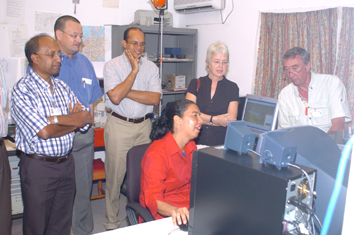
The overhauled Meteo segments, which are produced by the National Meteorological Services (NMS) and aired after the SBC’s 8 p.m. news, are the result of funding and training support from the UK Meteorological Office worth 35,000 UK pounds.
The UK Met Office, through a voluntary contribution programme, has also donated 13,760 UK pounds worth of basic meteorological instruments like rain gauges and thermometers, the likes of which were wiped out at many NMS stations during the December 26 tsunami last year.
An upgrade of the upper air observing system at Rawindsonde Station has also been carried out at a cost of 23,429 pounds with the UK’s assistance.
British High Commissioner Diana Skingle and Minister for Environment and Natural Resources Ronny Jumeau met at the NMS airport-based headquarters at Pointe Larue for a short, and mostly symbolic, handing-over ceremony for the equipment, the majority of which has already been installed.
The ceremony was also attended by environment principal secretary Rolph Payet, the director general of the National Disaster Secretariat, Michel Vielle, the managing director of Seychelles Broadcasting Corporation (SBC) Ibrahin Afif, NMS officials and meteorologists.
Acting NMS director Denis Chang-Seng said that 10 years had passed since the NMS first enacted its Public Weather Services on television. He noted that the new system would be one component toward the much-talked-about early warning system for Seychelles and the region.
The presentation software is highly customizable, allowing for segments to be inserted – in addition to the regular displays for wind, temperature and tides – to notify the public of special weather information or emergency bulletins, he added.
Training and installation of the new equipment has been carried out under the supervision of Bryan Bettani, a sub contractor linked to the UK Met Office who helped install the original system 10 years ago.
Some of the technical gadgets for the new presentation system are “exactly what they use on the BBC,” he said.
Mr Payet said the NMS was “one of the few remaining places where the British have given assistance and the equipment is still operating, for example our hydrogen generator, which is older than me and still going strong.”
He underscored the importance of the Public Weather Service, saying that new state-of-the-art forecasting equipment recently acquired by the NMS was only as good as the benefits they could generate toward saving lives and property.
“Without clear communication and understanding of such natural phenomenon by the public there is no way we can educate them in disaster prevention and risk mitigation,” Mr Payet said.
HE Ms Skingle noted the long tradition of cooperation and collaboration between the UK Met Office and the NMS. The upper air observing system, for instance, was funded by the UK 30 years ago.
The NMS also regularly benefits from the UK Met Office with an annual supply of weather balloons and other consumables worth 85,000 pounds.
In turn, weather observations made from Seychelles by the NMS contribute to the global forecasts and models produced by the UK office, Ms Skingle added, speaking of the “remarkable friendship and interdependent support that cements the international meteorological community.”