


Airport fire service-Seychelles makes another regional first |23 January 2006
The experts made the declaration while speaking at Seychelles International Airport on Friday after an E-One company representative handed two state-of-the-art engines which only recently came into the market worldwide, to the chief executive officer of the directorate of civil aviation, Gilbert Faure.
“I have been to all airports in Africa and the Indian Ocean and I know none of them has equipment of this nature or cost," Trevor Fiford, E-One's representative for Africa told Nation after demonstrating how the six-wheel-drive 40-tonne machines operate.
He said that the U.S.-made E-One R3.8 million apiece engines are run by computer and went into the market only 18 months ago globally and only some airports in Europe along with others in the U.S. operate them.
"One of their main advantages over others is their independent suspension on each of its six driving wheels, which makes the fire engine run quite fast even over rough terrain," he said.
“Their equivalents have fixed suspensions and tend to jump up and down on uneven ground which greatly reduces their speed,” said Fiford.
"During an emergency you want to reach an aircraft that is on fire as soon as possible using the shortest route," he said, after demonstrating that the E-Ones could reach speeds above 80 kilometres per hour (50 miles an hour) in 28 seconds.
He said each of the vehicles has four computer systems enabling one man to operate all three of the machines' main applications.
Each of the new vehicles carries 11,356 litres of water, 1,515litres foam and 226 kilogrammes fire fighting chemical powder.
The airport's chief fire officer, Marc Brutus, said that the country had elected to purchase the best possible equipment, and had tested alternative engines in Europe, U.S and Australia.
"A single driver can spray water, foam and chemical fire retardants at the same time," he said, adding that each of the vehicles has a powerful electricity generator and can supply all the light required at a site.
“We have risen to the highest level worldwide which is ‘Category 10,’” Mr Brutus said.
He also said that there are fire hydrants all along the runway, which itself happens to run along the sea shore, “so even if we ran out of water, the machines can always draw some from the ocean during a fire emergency.
The 40-tonne apiece machines added to a formerly-existing fleet that had three 32-tonne engines, and the airport now exceeds International Civil Aviation Organisation's (ICAO) requirements of emergency preparedness, Mr Brutus said.
He said that the highest ICAO category of fire service station requires a base to have a minimum of 30,000 litres of water but the combined fleet now has 48,000 litres of water, and that even if one of the five vehicles broke down, the minimum standard would still be maintained.
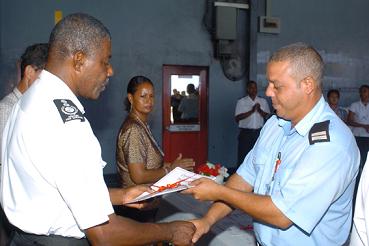
During the ceremony, 25 fire fighters who had been trained to operate and maintain the new fire engines received their certificates.
Mr Fiford said their competence of a high and admirable level while Mr Faure urged them to take good care of the new machines, saying if they are looked after well, they should last between 10-15 years.
Mr Faure thanked the government for the investment, and all those who had been instrumental in the procurement of new engines, including, the Chief of Staff of the Seychelles People’s Defence Forces, Colonel Leopold Payet, who was present at the ceremony and boarded one of the vehicles during the demonstration.
