


Forgotten frogs in focus |04 December 2006
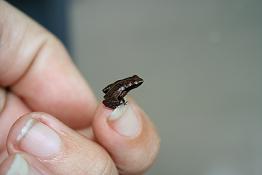
Commonly known by their scientific family name, Sooglossids, the frogs are only found on Mahe and Silhouette and, thanks to their elusive nature, hiding in leaf litter on the forest floor, and small size – the three species range from only 11mm to 45mm in length – are amongst the least studied of Seychelles' animals.
The project to formulate a monitoring system in order to increase knowledge of the Sooglossids
"At present we know very little about the Sooglossids, but, due to their limited distribution, the three species – Sooglussus gardineri, Sooglossus sechellensis and Nesomantis thomasetti – are regarded as either vulnerable or endangered by the IUCN," Dr Naomi Doak of Nature Seychelles said.
The project started in August and will continue into 2007 to develop a system that takes into account differences between the frogs' dry season and wet season distribution and activity patterns.
Research work by Dr Doak and Nature Seychelles' Field Assistant Ian Valmont has focused on the Morne Seychellois National Park, where the undisturbed leaf litter provides a year-round moist home for the frogs.
"The Sooglossids appear to be much more common in the forests of the Morne Seychellois National Park, than in areas to the south. This is perhaps because the vegetation and soil in the national park hold more moisture than that in the south," said Miss Doak.
Sooglossids are independent of standing water, their tadpoles either being carried on the parents backs or hatching directly from eggs laid in damp leaf litter.
Once in place the monitoring programme will also provide information on whether the frogs, the entire family of which is only found in Seychelles, are restricted to the mountainous forests or if they are able to live in damp areas close to streams and rivers at lower altitudes.
With high levels of protection afforded to the national park, frogs living within its boundaries are relatively safe from human disturbance; however, populations outside the park may be under threat from development projects.
Around one third of all amphibian species, which include frogs, toads, salamanders and caecilians, are estimated to be at a high risk of extinction and over 120 species are believed to have disappeared within the last 25 years.