


ISLAND CONSERVATION SOCIETY-Two obscure islands, one famous plant and a transvestite |10 September 2007
The French frigate Boudeuse and its store ship Etoile circumnavigated the globe in 1766 to
Philibert Commerson sailed on this voyage as naturalist, together with his assistant Jean Baret. Commerson and Baret collected some 5,000 plants including about 3,000 species new to science. Their discoveries included one from Brasil which was to become synonymous with the tropics. They named it Bougainvillea after the ship’s commander, Louis de Bougainville, the first French captain to sail around the world.
In January 1768, the ships entered the Pacific via the Straits of Magellan. By April, they reached Tahiti. No sooner had Commerson and Baret disembarked to search for plants, when the islanders began to chant the word “aiene” meaning “girl.” They seized and stripped Baret. The French crew leapt to the rescue then stood back in astonishment when they discovered their dishevelled shipmate was in fact a woman. Jean was re-christened Jeanne! Apparently, Jeanne had dreamed of sailing round the world, but this was a job for a man.
When her secret was revealed, Commerson initially claimed to be as surprised as the rest of the crew but it later transpired he had been living with Jeanne for four years. Quite how the Tahitians were able to work out in five minutes something that had escaped a shipload of hot-blooded Frenchmen for two years, history does not reveal. A surprised Bougainville recorded in his diary, "I must do her justice to acknowledge that at all time while she was on board ship, she was the model of propriety."
By November 1768, the ships reached Mauritius. Here Commerson met the famous Pierre Poivre and the two botanists got on very well. Poivre persuaded Commerson and Baret to remain on the island, where they helped him to establish Pamplemousses Botanical Gardens. Just before Bougainville sailed, Commerson informed him that he would name one of his discoveries after the commander.
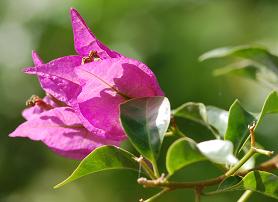
Today, the legacy of Commerson and Baret can be seen in practically every street and garden of Seychelles, adorned by colourful sprays of Bougainvillea. Its attraction is the bright paper-like bracts surrounding the small white flower (in some countries it is called Paper Flower). In fact, there is not one species of Bougainvillea but several. Most of today’s varieties are the result of interbreeding amongst three of the eighteen recognised species.
B. spectablis is a large climber with characteristic arched thorns. It bears fairly large crinkly oval bracts which vary in colour from rose to purple. B. glabra has very thin spreading branches and characteristic triangular bracts that are typically in the range from white, through lilac to purple. They flower continuously all along the branches. B. peruviana has looser, more open branches with terminal inflorescences. The roughly circular bracts are very delicate and crinkly, usually in shades of magenta.
As for Commerson, he remained in Mauritius for five years, collecting here and on neighbouring Madagascar. He died on the island at the age of 44 and as he had wished, Baret catalogued their collection, packed it up and transported it to France, becoming the first woman to circumnavigate the globe. The adventure over, she died in obscurity.
The Island Conservation Society promotes the conservation and restoration of island ecosystems.
By Adrian Skerrett