


Book Review-The painful birth of our nation |31 May 2008
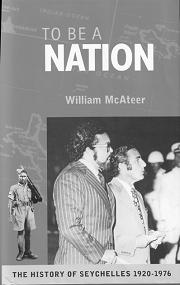
McAteer sets the tone in his introduction, describing as he picks up the story a “shamefully neglected colony” that produced a people who would remain for many years ill-equipped to govern themselves.
He adds to that a catalogue of argument, rivalry and dissent perhaps inevitable in such a small society – grands blancs planters set against their workers, planters against governors, governors against church, church against church.
All of this, plus the often bitter clashes between local politicians when true party politics finally emerged, had a damaging effect on the country’s development.
And even when it seemed, in the mid-1960s, that Seychelles was moving at last towards some form of self-government, Britain suddenly showed a hitherto unknown level of interest as it realised the country’s strategic value, with the Americans alongside, as a potential military base.
Britain now wanted to hang on to Seychelles and set up the British Indian Ocean Territory, taking the islands of Aldabra, Farquhar and Desroches – in return for the promise of an international airport on Mahe – to add to the Chagos archipelago from Mauritius.
In the end the US base was built on Diego Garcia, and McAteer describes in detail the disgraceful evacuation of its people, against their wishes, that followed. By the mid-1970s Britain no longer needed Seychelles and, as the author makes clear, was only too happy to move swiftly to independence.
That this did not happen peacefully was the result of another unfortunate situation in what governor Sir Charles O’Brien called “this contentious colony” – the fact that such a small place should produce two gifted political leaders of equal stature in James Mancham and Albert René. And further, that they headed parties with diametrically opposed aims – Mancham wanting integration with Britain and René finally pressing for independence – while claiming almost equal support from the electorate.
The later chapters of McAteer’s book, dealing with the rise of the SPUP and SDP parties and the confrontations that followed, will doubtless be of greatest interest to the average Seychellois reader, but there is much else that is absorbing and enlightening here.
To Be a Nation is a thoroughly researched and well presented piece of journalism, as might be expected from the former editor of the Mombasa Times and head for several years of the school of journalism at the University of Nairobi. McAteer can also claim extensive local knowledge as he first came to Seychelles in 1955, married a Seychelloise and has lived here for the past 14 years.
There are several strands to the book, some of them running throughout – such as the poor living conditions and pitifully low wages of the mass of Seychellois, set against the paranoid hatred of the planters for any kind of tax increase that might improve matters.
The influence of the owner class, which found expression in the Planters’ Association – later the Taxpayers’ and Landowners’ Association – is a recurring theme right up to the 1950s. The power of the Roman Catholic Church, too, hovers over the book leading to a showdown between church and governor on the education system and dominance of the French language in schools.
Bishop Maradan finally admitted defeat on that issue in 1960 when Sir John Thorp was in charge, but other governors had less success with their various campaigns.
One of the perhaps surprising facets of the book is that despite the appallingly low level of interest the British government showed in Seychelles – which meant the colony was almost constantly strapped for cash – several governors were sympathetic to the plight of the average Seychellois and worked hard to improve it.
Two of these stand out – Sir Eustace Edward Twisleton-Wyckham Fiennes (1918-21) and Sir Percy Selwyn-Clarke (1947-51) – and it is fitting that both their names can still be seen around Victoria.
McAteer describes Fiennes as “the reckless reformer”. His project for a new Victoria hospital was, it is true, not well planned financially and left a substantial debt hanging over the colony but it was badly needed. The Fiennes Institute, too, was a major step forward in properly caring for the destitute, who had been confined together with leprosy sufferers at camps on Round Island, off Praslin.
Selwyn-Clarke – appointed by the postwar socialist government in Britain because he “possessed a social conscience” – was keen to further the political and social progress of the colony.
His campaign of raising taxes to introduce reforms in such fields as public health, labour law and a minimum wage – in which he was readily helped by local barrister Charles Evariste Collet whom he named acting attorney-general – was apparently known locally as the “reign of terror”. It was an uphill struggle, and Selwyn-Clarke was withdrawn from the colony with many of his ideas unfulfilled.
McAteer’s book is not just about the British rulers, though, and he devotes much space to the Seychellois who left their mark in various ways. As a group they came into their own during the second world war when in North Africa and Italy they made a valuable contribution to the Allied effort.
Shaking off the image they had previously had in some quarters as a lazy and unreliable workforce, they were now highly regarded, one company being described by a British major as achieving “a reputation for work and discipline second to none”.
Individual Seychellois to whom the book pays tribute include Union Lighterage winchman Joseph Eulentin, who was the first to articulate the desires of the silent majority of Creole workers in the 1930s; stevedore Joachim Arrisol, who became a member of the Legislative Council where he worked tirelessly for all classes of society; Harry Payet who, in the 1950s, spoke out at public rallies on the need for radical change.
Change did come with independence in 1976, but McAteer notes that it seemed doomed to failure from the start as the first president, James Mancham, had an extraordinary level of power conferred upon him by the mixture of French and British forms of government.
Last governor Sir Colin Allan referred to fears that Mancham had been given “such an excess of power as to almost constitute a negation of democracy” and Ted Rowlands, the British minister newly in charge of colonial affairs, was accurate when he said: “Our expectation is that Albert René, the leader of the SPUP, will take over in due course.”
To Be a Nation by William McAteer is published by Pristine Books.
R. M.