Adult literacy programme celebrates 30th anniversary |28 August 2008
Its inception
The adult literacy programme was started in 1978 with the support of UNESCO to improve the country’s literacy rate which was 61.1%. The programme was for people over the age of 15 and they learned how read and write in English and French and gained basic numeracy skills. It was offered in only three districts on Mahe – Grand Anse Mahe, Anse Aux Pins and Mont Buxton -- and the instructors worked on a voluntary basis.
In 1979 the National Development Plan (1979 – 1983) was formulated. Literacy was conceived as an element of nation building, and it was stressed that functional literacy programmes have to reach a wider section of the community to give the strategy of establishing equitable provision its due recognition. Contrary to the older view of literacy as purely the ability to read, write and count, functional literacy looks to provide participants with the knowledge and skills that would allow them to function effectively in all aspects of their lives and in their role as members of society.
In 1981, Creole was established as a national language and it was also introduced into the adult literacy programme.
Materials were produced to be used in the teaching of Creole. During that year Seychelles joined the rest of the world to celebrate the International Literacy Day on 8th September and successful participants of the adult literacy programme were awarded certificates of achievement.
In 1985, a new programme for personal and national development was launched following a review of the adult literacy programme. After this, the Ministry of Manpower recognized the English level 3 Certificate as appropriate qualification for obtaining certain jobs.
The first adult literacy survey in 1982 revealed that success had been achieved under the programme. The literacy rate stood at 82.8%. At this point instructors started receiving a monthly allowance for teaching on the adult literacy programme. In the meantime new literacy centres were opened in other schools, crèches and homes of instructors. As a result, the number of participants increased. The census revealed continuous improvement in literacy from 87.5% in 1994 to 91.1% in 2002. This was a sure sign that progress was being made.
Who are the participants?
The literacy programme caters for adults and out of school youths who still require a sound basic level of education. The belief that literacy is a thing for the old is losing its effect as more young people are enrolling on the programme, which allows them to obtain their basic education so that they may stand a greater chance of being employed.
Do we still need a Literacy Programme?
Literacy is an integral part of the right to education which our Constitution guarantees. It plays a major role in empowering adults by raising their self-confidence, critical thinking, awareness of their needs, their society, the world and propels them to take positive steps for theirs and their family’s development.
Seychelles is working towards the achievement of virtually 100% literacy by 2012. This goal is in line with the UNESCO Literacy Decade (2003 – 2012) goal to achieve at least 50% global literacy rate.
What’s the way forward?
The literacy programme has come a long way from three centres to 24 centres over Mahe, Praslin and La Digue with some of the centres being in workplaces. Certificates of achievements are awarded annually for English, Maths, French and Creole. Work is ongoing to continuously improve the standard of provision of the service so that more employing agencies will recognize the importance of the certificates. The Ministry of Education endeavours to get the collaboration of more employers to support the educational development of their employees.
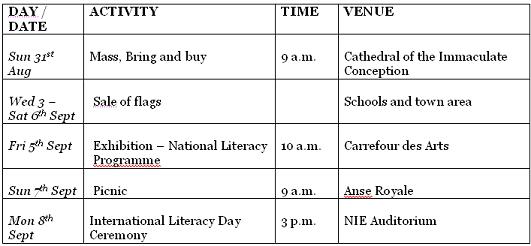
Programme of activities to commemorate 30 years of achievement.
Adult Learners Week 2008
NATIONAL PROGRAMME
Date: Monday 1st September to Monday 8th September 2008