


ISLAND CONSERVATION-What’s in a picture? |08 September 2008
“You should have been an archivist, not a journalist or naturalist,” Xavier said in between two sips of tea. “Hey, careful you don’t spill tea on that purple binder to your left!”
Transferring my own cup to my right hand, I reached for the file. It was labelled “Valdivia”. I recognised it to be the name of the famous steamship that carried the German deep-sea expedition to the Indian and Pacific Oceans at the end of the 19th century. “I remember compiling this dossier!” I cried. “There are some interesting photographs. Let me show you…”
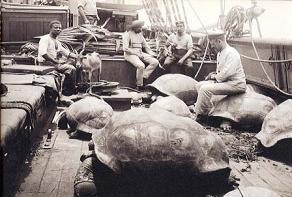
Xavier was fascinated by the photograph of the crew of the Valdivia lounging on deck, surrounded by at least eight giant tortoises of varying sizes. He pointed to one that was being used as a stool by a moustached sailor. “The expedition obviously stopped over in Seychelles,” he said. “But did they go to Aldabra to collect these tortidter?”
“I’m pretty sure they didn’t,” I answered. “It would seem they visited only Mahé and Praslin. I believe they got Aldabra tortoises that were being kept in the granitic islands. Look, you can actually make out bits of tortoise droppings here and there on the deck!”
Looking through the notes with the photographs we read that the Valdivia left Hamburg on the 31st of July 1898, and visited the Canary islands, Cameroon, South Africa, Kerguelen, Sumatra in Indonesia, the Maldives, Diego Garcia and Seychelles (5th–8th March 1899) before getting back to Hamburg on the 28th of April 1899 via the Red Sea, after nine months at sea. The expedition leader, the famous German zoologist Carl Friedrich Chun (1852-1914), published an account of the expedition entitled Aus den Tiefen des Weltmeeres (“From the Depths of the World’s Seas”), but I told Xavier that I found the prospect of trying to navigate through 592 pages of 19th-century German - in Gothic script, if you please - somewhat daunting: pye kapisen alone becomes Kapuzinerbäumen in Chun’s text, and golan blan is Feenseeschwalben!
Xavier kept pointing to interesting details in the photograph: the non-European man (a Seychellois?) on the left, one hand appearing to be gently stroking the back of a goat (from Aldabra?); two monkeys between the two crew members on the right; a pile of palm-leaves (coco-de-mer?) behind the man with the goat…
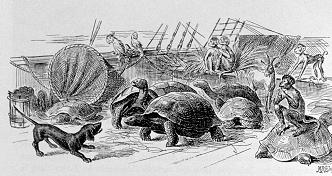
Also in the old file there was the drawing, from Chun’s book – a more humoristic view of life on the deck of the Valdivia, with monkeys replacing all the crew members now and a pair of parrots and a sea turtle thrown in as well. I drew Xavier’s attention to the net, of the type used by Carl Chun and his team to collect deep-sea animals while they cruised along at 10 knots.
Strange for a deep-sea expedition, there was also a botanist interested in land plants on board the Valdivia. This was Andreas Franz Wilhelm Schimper (1856-1901), who collected not only seaweeds but also some 140 specimens of plants that grow inland on Mahé and Praslin.
He was apparently the very first botanist to collect the endemic larourout-de-lenn maron, which he found on “Mount Harrison” (actually Montagne Planeau). One of our rarest endemic plants, the milk vine or lalyann dile has been given the Latin name Secamone schimperiana to honour Schimper.
As Xavier and I continued with our dusting and sorting out of my books and papers after that break, I thought, too, of the international political context at the time of the visit of the Valdivia. Historians point to the fact that Germany was not yet a major maritime nation before the 1870s. But, in the words of Professor Gerhard Kortum of the University of Kiel, the success of the Valdivia deep-sea expedition helped to raise German confidence and self-esteem and “Germany now felt able to compete with England almost on equal terms and certainly felt a need to assert a superiority over lesser countries… The general advancement of knowledge sometimes was a welcome alibi for the promotion of political and commercial interests overseas…”
History, of course, repeats itself and superpower rivalries are far from over.
by Pat Matyot