


Christine Chetty’s colours of life |18 April 2009
Although the artist has taken 10 years to stage her next exhibition, she has been actively taking part in many national and international exhibitions, including World Bank Art – Africa Now in Washington DC, USA, last December.
An artist who is fully committed to teaching fine art at Seychelles Polytechnic, Christine still makes time to pursue her passion in art as well as manage her family.
For this artist, family extends beyond the immediate circle to her ancestors, who though no longer physically present in her life, still vividly converse with her through her dreams and in her meditations, to inspire her artwork.
Christine confided that as a practitioner of transcendental meditation, commonly known as TM and popularised internationally in the Sixties and Seventies by Maharishi Mahesh Yogi, the famous guru of the Beatles, she will often see her paintings in the meditative state before actually producing them.
It is known that many artists who are able to tap into higher consciousness through the regular practice of meditation have often reported similar experiences, which will often inspire artwork –sometimes of a spiritual or contemplative nature – or work that may be very innovative as well as different from what the artist has done previously.
This is very evident in Christine’s work and is an example of her continuous progress and artistic development.
This current exhibition is dedicated to her great-grandmother Adel Barbé, born seven generations ago in 1808, and who is her source of inspiration as she cuts, stitches, patches, folds, creases and embellishes her unique artworks, which evoke many experiences, memories, origins, personal and ancestral histories, as well as preoccupations that inform the artist’s postmodern art themes such as ethnicity, culture, gender, religion, spirituality, creation myths, female sexuality and eco-feminism.
Many postmodern artists are at this time producing artwork that addresses issues which are about values – social, cultural, economic or political – as well as having religious or spiritual significance, which often will stir your conscience, question your beliefs or challenge your perspective on controversial subjects.
Christine Chetty’s work poses a number of questions within a number of different contexts and every viewer will determine how and what to respond to individually.
As an artist and writer, I much prefer to sit quietly alone with artworks and let them work on my consciousness and talk to me until they reveal themselves to me, and often they don’t say what they mean at first viewing.
Although the titles do not help you very much in understanding her art, Christine’s multi-media works combine several disciplines and skills such as fine art, design, and crafts with painting, formal design elements, fabric collage, quilting techniques, hand and machine stitching.
She uses a variety of media such as acrylic paint, discarded fabrics, hessian, colourful bags of cloth from India imprinted with product names and inscriptions in Hindi or Tamil and embellished with fashion accessories such as beads and braid, all of which evoke not only a feminine touch but also many universal and personal symbols, personal and ethnic associations, and emotions that range from the spiritual to love and sex, eco-consciousness, as well as the death of close friends and family.
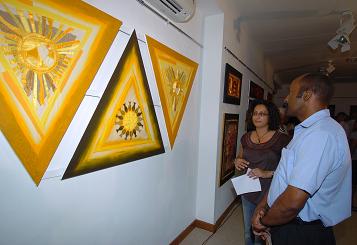
Stand for a while in the gallery and look at Soley, Lavi, Lalimyer (No. 4): you will see symbols of the light of divine consciousness represented as a vibrant lemon-yellow sun surrounded by fish, symbol of Jesus Christ.
Kwen Tapi Adel (No. 12) is a simple tribute to her grandmother, in which pieces of coloured cloth are carefully folded artistically and enclosed in a circle, all of which is a metaphor for a seasoned quilt maker.
As I stared at this centre piece I suddenly realised it was like staring down at an aerial view of ‘en bake lenz’ (a bucket of clothes), and I thought: nothing could be more traditional with our Seychellois women than ‘kwen tapi’ and ‘en bake lenz’.
Kouler Later (No.4) refers not only to earth colours but also to the grave of the artist’s late aunt Yvanna, a deeply religious woman who arranged flowers in church. The symbol of the cross created with a floral patchwork evokes memories, love, the woman’s religious fervour, her love of flowers, as well as the flowers growing on her grave.
As I listened to Christine during the course of our long interview, she repeatedly stated: “My artworks are full of stories!” And in her catalogue she quotes Clarissa Pinkola Estés, the famous author of Woman Who Runs with the Wolves, who states: “Stories are medicine.”
And Kouler Later is a piece of work that helped to heal the pain of loss, just as Christine confided that Death Bed (No.2) is a remembrance of a dear friend who passed away with a terminal illness two years ago.
On a more positive note, you will love Untitled (No.22), a work not listed in the catalogue. However, as you look at it closely you will see a newly married couple waltzing within an archway, surrounded by a pathway of red threads and a tiny bed decorated with Indian motifs inscribed on them.
The fabrics around the image evoke wedding gowns and bridesmaids’ dresses; and the out-stretched palms on the edge of the frame are a metaphor for all the fingers hoping for that golden wedding band, still significant to many women in these times of serious infidelities and loose relationships.
Pyeste Kouler Lavi 2 is definitely the most intellectual, meaningful and visually engaging art exhibition in this first quarter of the fine art calendar of 2009. Go and see it. But don’t just give it a casual glance and walk out. Sit and experience it.
Let the images and vibrant hues speak to you and arouse your thoughts and feelings, and you will soon begin to understand what a skilled and highly intellectual artist can do to enhance your experience, understanding and enjoyment not only of art but also of life.
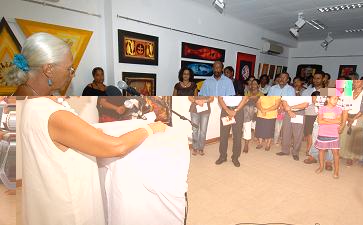
Pyeste Kouler Lavi 2 runs through to April 27 at the National Arts Council Carrefour des Arts gallery, National Library car park, from 8-4, weekdays only. The exhibition was officially opened on April 3 by the charge d’affaires at the Embassy of the Sovereign Military Order of Malta, Francesca Alexandra Azais, in the presence of the Minister for Community Development, Youth, Sports and Culture Vincent Meriton among other guests.
Peter Pierre-Louis