


Sea turtle behaviour and conservation on Alphonse Island – Part 2 |23 September 2013
How we make sure baby turtles find the sea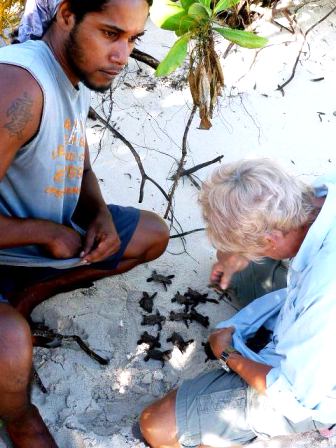
Visual orientation of hatchling sea turtles
Hatchling sea turtles emerge from the nest when ambient temperatures are relatively low, therefore emergences happen generally at night (but can also happen during rainy daytime, at dusk or at dawn).
The time spent crawling down the beach to reach the sea, needs to be short. They have to go fast to avoid terrestrial or aerial predators. Vision is the key sense for successful hatchling orientation and, in a completely natural environment, hatchlings will be attracted by the natural light (especially in the blue range) that is reflected from the sea surface.
It is helpful to them when light from the moon or stars reflect off the ocean but they can find the sea even on a completely dark and overcast night. Unfortunately, their attraction to light makes hatchlings vulnerable to being drawn to artificial lighting. Even in a bright moon night the turtle will be attracted by an even brighter illumination source, and so artificial light can disrupt the hatchling sea-finding behaviour.
Because such light usually comes from a source on land behind the beach, it tends to draw the turtles inland where they become exhausted, dehydrated, and subject to predation by animals such as crabs.
ICS and hotel on Alphonse Island work together to minimise light pollution
On Alphonse, the Island Conservation Society (ICS) and Alphonse Island Resort use a number of strategies to reduce light pollution visible from the nesting beach. The hotel equipped its guest house outdoors with red bulbs, a colour to which the turtles are less sensitive.
We ask the tourists to turn off unnecessary lights inside their rooms. Lights on the roadways have been made more ‘turtle friendly’ by placing them at ground level and using dimmer bulbs. Because we keep track of all the nests near the hotel, we know when each is expected to hatch.
So, prior to their anticipated hatching date, we set up a screen of coconut tree leaves behind the nest to shield the new born hatchlings from visible artificial lighting. Our actions to minimise the light disturbance have greatly improved the hatchling survival on Alphonse and very few disorientation events happen now. The staff and guests of the Alphonse Island Resort have also shown great concern for the welfare of the hatchlings, and are very happy to help us in our efforts to protect these tiny creatures.
Aurélie Duhec
Island Conservation Society