


Bel Ombre again in the limelight |07 October 2013
Recently we were excited about the discovery of a caecilian with a clutch of eggs at Bel Ombre. Two weeks ago, we noted with sadness the death of one of our endemic birds, the Seychelles kestrel, Falco araea, also at Bel Ombre. The bird was found dead by school teachers at the Bel Ombre primary school on Monday September 23.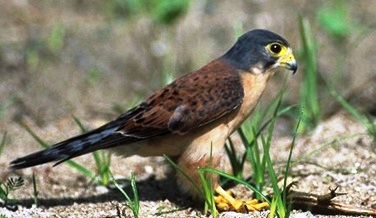
It was Terence Vel who called us at the Natural History Museum to see if we were interested in having the bird. As we would be benefittting from the service of a taxidermist from Reunion in the near future, we thought that the kestrel would be a good specimen for him to work on during his visit and the stuffed bird would also be an added attraction in the museum.
The Seychelles kestrel, “Katiti” as we know it locally, is a small falcon with dark reddish-brown plummage on the upperparts. The head is dark grey, and the underparts are buffy (yellowish-beige colour). The female is slightly paler than the male. The Seychelles kestrel is very agile in flight and it has a relatively long tail. Its total length is between 15 and 23cm.
The Seychelles kestrel, like all falcons, is a bird of prey and feeds mainly on geckos and skinks, but also consumes insects, small birds and mice. It hunts from the vantage point of a perch, and snatches its prey from tree trunks, branches, foliage or from the ground. It lays only one brood of two to three eggs each year, generally from August to October. It does not build a nest, but lays its eggs on cliffs high above sea level, in tree holes or on building ledges, and the incubation period is around 30 days. The young appear in the nest when food availability is at a maximum, giving the chicks the best possible start in life.
Both the common myna (marten) and the black rat, prey on the nests of Seychelles kestrel, and despite the parents’ efforts to defend the territory and nest, not all chicks will reach fledging at 38 days of age.
The Seychelles kestrel is classified as vulnerable (VU) by the IUCN (International Union for Conservation of Nature) Red list, and listed on Appendix 1 of CITES (Convention on International Trade in Endangered Species).
If you do come across any fresh, dead bird (any bird), please contact the Natural History Museum on Tel. 4321333 ext. 8231 or 8151