


President’s coral appeal goes global |21 December 2004
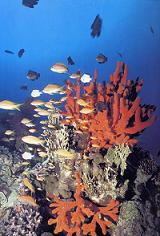
The call comes in the two Presidents’ joint foreword to a global report on coral reefs, the Status of Coral Reefs of the World 2004, which was released simultaneously at the headquarters of the Worldwide Fund for Nature (WWF) in Washington and at the United Nations climate change conference in Buenos Aires last week.
The report warns that while the more isolated reefs of the South Western Indian Ocean such as those of southern Seychelles “remain relatively healthy and untouched” by land-based human activities, they have however been affected by coral bleaching and “are threatened by over-fishing and the poaching of sharks”.
The international survey by 240 experts in 96 nations, including Seychelles, is published by the Global Coral Reef Monitoring Network (GCRMN) and the International Coral Reef Initiative (ICRI). Seychelles currently co-hosts the ICRI secretariat along with the United Kingdom.
Coral reefs are probably the most endangered marine ecosystem on earth, the two Presidents say in the foreword, as most reefs around the world are over-exploited and damaged by pollution, excess sediment and inappropriate development.
Scientists predict massive destruction of coral reefs in the next decades because of increasing global climate change, they warn. The loss of these reefs will destroy the social fabric of many coastal communities and ruin an important tourism industry that supports many tropical countries and especially small island developing states (SIDS) such as Seychelles and Palau.
The Republic of Palau is made up of more than 200 volcanic, limestone and coralline islands in the western Pacific with an exclusive economic zone (EEZ) of 629,000 sq kms but a population of only 20,000.
“Coral reefs are especially important for some of the smallest and most vulnerable countries in the world,” say the two leaders. For SIDS, for example, ecotourism based on healthy coral reefs offer the best chance to develop sustainable economies.
“We are convinced that with improved commitment, collaboration, cooperation and communication, future generations will be able to enjoy the beauty and benefits of the world’s tropical and cold water coral reefs,” they add.
The GCRMN report warns that some 70 percent of the world’s coral reefs have been destroyed, are severely damaged or are at risk from human activities, up from 59 percent only four years ago. Nevertheless some are showing surprising resilience to global warming.
“Twenty percent of the world’s coral reefs have been effectively destroyed or show no immediate prospects of recovery,” says the report. Another 24 percent “are under imminent risk of collapse through human pressures, and a further 26 percent are under a longer-term threat of collapse”.
Even so, some reefs have recovered sharply from the 1998 bleaching which seriously damaged 16 percent of all reefs worldwide, especially in the western Pacific and the Indian Ocean. Most of the recovered reefs are in the Indian Ocean, part of Australia’s Great Barrier Reef and in the western Pacific, especially Palau.
The report states, for example, that extensive surveys of Seychelles’ inner granitic islands show an increase in reported coral species that “indicates that the biodiversity of the reefs is slowly recovering after the initial fear that many species had become locally extinct in 1998”.