


Dental survey results released |20 January 2006
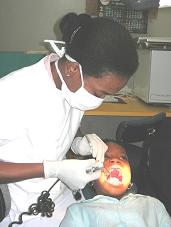
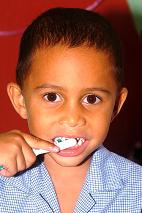
However, the manner in which they do so is largely ineffective and they still suffer dental carries and gum disease.
Dental therapist Kathline Ernesta said this Thursday January 19 at Victoria Hospital, where she also disclosed that there has been a slight improvement in the overall dental health of children.
“A total of 595 children were selected for the survey and 550 turned up,” she said, adding that the survey was carried out by staff of the School Dental Services unit (SDS) together with a team from the University of Umea, Sweden.
“Among the people involved was a professor who also helped us conduct a similar study in 1994,” Mrs Ernesta said.
She said that the survey involved survey on three groups of children, aged six, 12 and 15 years.
“The results are as we were anticipating since we see children daily at the dental clinics,” she said.
She said that over the past 10 years, there has been some improvement with regard to the brushing of teeth and avoidance of sugary foods by the children. She said the change is encouraging.
“But we are still not satisfied because the percentage of children experiencing dental decay is still high, and 75 percent of our children experience dental decay,” she said.
She said that among the six-year-olds, 78 percent have decay in their baby teeth, with an average of four teeth per child being affected, and 10 percent experience decay in their newly erupting permanent teeth.
“Among the 12-year-olds 63 percent are affected, with an average of 1.5 teeth per child decaying and this is better than the 2.0 teeth per child target the Department of Health and the World Health Organisation had set,” she said.
He attributed this to the efforts of parents, the children and her unit.
“For the past five to six years, we have focused our school programme on P5-P6 classes, making sure that we see all of those children, and we see that the decay rate is decreasing, in 1994 it affected 3.2 teeth per child but a 1998 in-service study showed it was 1.9. The recent study shows it has now dropped to 1.5 teeth per child,” she said.
Asked what lacks in the way children brush their teeth, Mrs Ernesta said that children fail to reach the back teeth while brushing and it is the gum around those ones that is most affected.
Decay, however, arises due to sugary foods being taken in between meals and affects all teeth.
She said that sugar helps to erode and replace the chemicals that strengthen the teeth, but when sugary food are taken with other foods, nutrients in the food repair the damage the sugary foods would have caused.