


Interview with Former President James R. Mancham-'This is no time for celebration' |28 June 2006
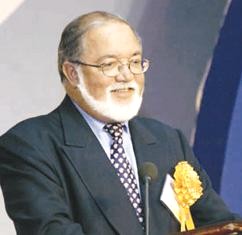
Mr James R. Mancham was the first President of Seychelles at Independence in 1976. His Seychelles Democratic Party (DP) had to form a coalition with Mr France Albert Rene's Seychelles People's United Party (SPUP) for Independence after Britain refused to grant him 'closer links'. We asked him about his impressions 30 years later.
Seychelles Nation: Mr Mancham, the people of Seychelles will on June 29, 2006 celebrate 30 years of the country’s Independence. Through this celebration, the majority of the Seychellois want to demonstrate the soundness of the decision taken 30 years ago to embrace this course of action and the extraordinary progress it has brought about. How do you feel during this time of celebration?
Mr James R. Mancham: Thirty years is certainly more than timely to draw up an honest balance sheet between the positive and negative factors which have characterized the three last decades. Of course it would not be fair and honest to put under the microscope all elements of material progress whilst keeping under lock the “cupboard” of missed opportunities, and the pains and sorrows which the nation have gone through. Considering that an important national election is due in July, this June should have been set aside for deep thoughts and honest questioning rather than for frivolous entertainment. With the nation being so sadly divided and the economy far from rosy, in my opinion, this is no time for any celebrations.
S.N.: At some point, your party (the Democratic Party) was against Independence but later turned round to form a coalition with the SPUP (Seychelles People’s United Party). Can you explain the underlying reasons for this sudden change of position in view of the fact that a few months earlier, notably on the occasion of the investiture of Governor Colin Hamilton Allan, you had called for all doubts to be removed with regard to the future of Seychelles by integrating it to the British Empire?
JRM: When Governor Colin Allan came to Seychelles I was Prime Minister. In a welcoming speech at the Victoria Stadium I said that the time had come for the British Government to react openly to the Democratic Party’s policy of 'closer links.' That day the Governor did respond – but the following day I was invited to Government House to be told that I should go to London to discuss the issue. In London I was told that whilst Her Majesty’s Government had declared at the UN that she was ready to give effect to the wishes of the Colonial people with respect to independence of the colonies, there was no way she could discuss 'closer links' in a situation where there was significant opposition to the idea. If 90% or so of the people were for it, that would be another matter. But as Mr F.A. René was ambitious and badly wanted to rule over the Seychellois, it became obvious that 'closer links' in the circumstances had become unattainable.
S.N.: Why, in your view, did Great Britain force you to accept your country’s Independence?
JRM: Britain at that time was interested in her own future. After breaking down her Empire, she was focusing on becoming part of Europe. I was concerned with the future well-being, comfort and security of the Seychellois people. The SPUP’s aggressive policy of 'Independence at all costs,' thus gave to Great Britain a window of opportunity to say 'No' to closer links and to pressure us to accept 'Independence.'
S.N.: The SPUP and DP took part in various Constitutional Conferences in London in preparation for Independence. It is surprising to note that no one had ever suggested the idea of organizing one of these meetings in Seychelles. Why?
JRM: It would seem to me that your answer to this question could be as good as mine. However, it is obvious that a pattern for Constitutional Conference had been established. The future of India, Ghana, Nigeria and other once components of the British Empire were all decided in Conferences held in London. It is, in my view, ridiculous for you to suggest that against a background of all these precedents, Seychelles should have insisted otherwise.
S.N: In retrospect, have you any regrets with regard to the way the political struggle in Seychelles had evolved before the country’s Independence?
JRM: Of course I deeply regret that because of his personal ambition and desire for power, Mr René had not joined his voice to mind and get the SPUP to support the DP’s demand for 'closer links.' If we had achieved this today we would be celebrating 30 years of a peaceful and prosperous life for all. Together we could have pressed the UK to give us a status like La Réunion enjoys with France. Hence we would have Euro as our currency and a passport which would have enabled us to work and settle anywhere in UK and Europe. In this way we would have become a beneficiary of globalization and not a victim of it.