


Domestic terminal |19 August 2006
Extension proposals
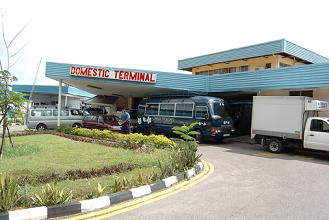
During the ceremony to receive the new Shorts 360 aircraft on August 5, Vice President Joseph Belmont talked of the need to upgrade the domestic terminal at Seychelles International Airport.
The director of the Seychelles Civil Aviation Authority (SCAA), Gilbert Faure, has sent the following details of the existing constraints and proposals being considered for the purpose of resolving the existing problems.
Background
The domestic terminal became operational in 1981, was constructed at a cost of R900,000, and had the capacity to handle 40 passengers at any one time.
However, passengers increased from 78,000 to 226,000 in 1994 as many travelled directly to Praslin, having arrived on international flights. This meant more passengers, baggage, tour operator activity and more vehicular traffic, a situation that posed severe pressure on the facilities and reduction in service standards.
A project to upgrade the terminal building and associated facilities was formulated in 1994 and implemented in 1995 at a cost of R1.3m. This provided increased capacity to allow handling up to 100 passengers an hour.
Improvements included doubling the departure area, provision of space for four check-in counters, two departure gates, enlargement of arrival areas, more space for operational staff and better access or exit and circulation area for vehicular traffic.
The extensions and improvements were the maximum possible given the limited space available.
Other improvements were undertaken after project completion. These were the construction of desks for tour operators, installation of high quality seats and air conditioning systems in the departure lounge.
After the 9/11 event, it was felt necessary to enhance security measures and security screening equipment were installed for passenger and cabin baggage screening.
Despite the various improvements carried out, traffic growth, character of traffic and growth in the various activities associated there with, there are serious operational and space constraints that must be resolved for the standard of secure area to be at par with that of the Praslin terminal and the international passenger terminal.
High standards
It may be noted here that 50% of the passenger traffic to Praslin is comprised of visitors to Seychelles and these passengers are exposed to very high standards of facilities and service that are available at other airports in the world over. It is therefore essential that similar standards are available in order that Seychelles’ image as a top class tourism destination is maintained.
Improvement of airport facilities is a continuous and dynamic process. However aviation is a capital intensive system and there is need for perspective planning with a vision for the next 15 to 25 years. In this context, various options will be looked at.
Details of current constraints at the terminal building facilities in the arrivals area are:
. Insufficient space for installation of proper baggage delivery system.
. Insufficient space for accommodating arrival passengers waiting for baggage.
. Insufficient space for tour operators’ representatives and other meeters and greeters.
. Lack of space for baggage trolleys.
. Lack of space for cafeteria.
. Sub-standard washroom facilities.
Constraints in the concourse area include space being highly insufficient and very congested especially after international flight arrivals. There is also inadequate space to provide for the needs of tour operators and other users.
Difficulties in the check-in, baggage and cargo handling areas are:
. Insufficient space for more check-in desks.
. No facilities for information or customer service desk.
. No space available for installation of proper baggage handling systems.
. Lack of accommodation for handling staff.
. Cargo handling is done using the same facilities used by passengers. This is highly unsatisfactory.
. Some requirements for baggage or cargo screening cannot be met as a result of lack of space to accommodate security screening system.
In the departure lounge, problems include:
. Insufficient space to accommodate current passenger volume. Serious problem when there are delays.
. Amenities are limited as a result of lack of space.
. Facilities for pre-boarding checks are insufficient.
. Passenger and cabin baggage screening is being done, but space required is limited and must be increased.
. Staff waiting on first floor have to pass through this lounge. Path is defined by a cordon.
. Cafeteria serves both passengers in the departure lounge and the public outside.
.Washrooms facilities are inadequate.
. No facilities for infants (nursery).
. A small “business class” lounge could be made available if there was space.
. Lack of space for commercial activities which could boost earnings for SCAA and increase services to users.
. No facilities for SCAA operational staff.
. Building requires extensive maintenance.
Ramp operation
The ramp tends to be congested and the wide body aircraft bay which has all necessary services and facilities is used almost all the time for domestic operations. This limits capacity for accommodating large aircraft.
A new Shorts 360 has joined Air Seychelles domestic fleet creating further stress on capacity.
Mixture of international and domestic operations is not quite acceptable and there is a
lack of space for proper storage of aircraft and baggage handling equipment.
At the moment, there is insufficient terminal kerb length and limited space for passenger drop off and pick up.
The current kerb is too high and inconvenient, there should be steps in their place.
Cargo delivery is done in same area used by passengers which is not ideal and the covered area is not high enough and poses a difficulty with baggage on roof rack of buses.
Development options
In the ongoing analysis, two options are being considered, namely the upgrading of present terminal building and construction of additional facilities on the landside to link with the terminal or the construction of a completely new terminal building with its own aircraft parking apron and required landside facilities.
In the assessment of the two options, the following will have to be taken into account:
Need to cater for traffic both passenger and cargo requirements for the next 15-20 years.
. The scope of commercial opportunities that the development can bring.
. The limitations with regards to availability of space.
. The overall land use plan as per the recommendations of the master plan of 1993 and a 2000 plan prepared in consultations with Singaporean consultants.
Upgrading current facilities
If this option is considered, there could be an extension of the current concourse towards the main road and a re-positioning of check-in counters to face main road and the creation of space for more counters and baggage handling systems.
There could be the construction of a first floor above the concourse. This area to be used by departing passengers and can be accessible to tour operators, airport staff and cafeteria while other amenities can be located there.
Access from the concourse can be via lift or staircase.
Security screening of passengers and cabin luggage can be located on the first floor.
After screening, passengers can go down to departure via lift or staircase, but the current departure lounge entrance needs to be blocked. The current staircase from departure lounge to current first floor would also require to be blocked with all staff gaining access to first floor via the concourse and the current departure lounge can be used only as gate lounge.
Other facilities, office space, space for commercial operations can be constructed in the area between domestic and international terminals.
Second option
Another option would be to have an entirely new building of similar style as the international and Praslin terminals with separate facilities for handling passengers from those of cargo.
Needs related to passenger, new, operational staff, tour operators, meeters and greeters, other airport users, taxis, etc can be met.
There would be a new design for terminal circulation roads with separate lanes and a new apron devoted entirely for domestic operations. A taxiway would be required from runway to domestic apron.
This way, needs of all operators can be met as well as requirements for aircraft fueling and screening, with sufficient parking positions.
Access to the terminal from the main road can be via current car park and there would be a shuttle service between domestic and international terminals.