


SEYCHELLES ISLANDS FOUNDATION-Vegetation of Aldabra |04 June 2007
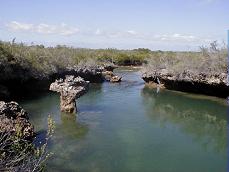
This is the Portuguese equivalent of the Arabic word Al-Khadra, meaning the green. The Portuguese could have been referring to the vegetation present during this time but possibly also to the green reflection that is seen on low clouds above the lagoon.
At the time when Aldabra was part of the British colony of Mauritius, the great naturalist Charles Darwin was moved to intervene when a woodcutting and timber industry were being proposed for the atoll. As time went by, scientists were intrigued by the fascinating animals on Aldabra, and botanists and plant enthusiasts were similarly lured to the shores to study the vegetation. However, in recent years they have been few and far between, so that vegetation studies have once again become a priority area for research.
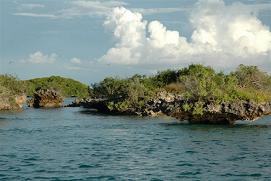
Low lying islands usually have a littoral (coastal) vegetation and Aldabra atoll is no exception, with an additional mangrove forest of Rhizophora (Mangliye rouz) and Avicennia (Mangliye blan) fringing the lagoon. With seven species of mangrove present, this habitat provides sanctuary for marine life and birds alike. Large areas of Aldabra are characterized by a dense and impenetrable forest of Pemphis acidula (Bwadamann) but other parts are covered with mixed scrub containing a variety of native species. There are more than 150 species of native plant, mainly of Madagascan and African affinities, including endemic species such as Lomatophyllum aldabrense (Zannannan mowo).A very special type of vegetation on Aldabra is tortoise turf, which is grazed by tortoises and looks like a neatly cut lawn.
Since the 1960s the vegetation has had to withstand some adverse effects, such as Icerya seychellarum (a mealy bug or coccid), which was introduced accidentally but is now partially controlled by means of an introduced ladybird which predates on the mealy bug. There are also several exotic plants species present on the atoll. One of these, Sisal (Lalwa), is mainly in small patches which can be controlled, but on Ile Michel a much more extensive control program is needed. Eradicating Sisal is no easy task. Proper clothing is an essential component against the irritating sap that causes a burning sensation and rashes. Care also has to be taken while uprooting or disposing of plant material as it can grow vegetatively, even from small cuttings. The cleared site also has to be inspected and monitored on a regular basis to assess the effectiveness of the control program. Stachytarpheta jamaicensis (Zepible) is more widely spread and its eradication seems impossible. So there is real challenge in preserving Aldabra’s unique flora for future generations and for scientific purposes alike.
Aldabra vegetation endures harsh climatic conditions during the dry season, from April to late October or November. When the wet season arrives, the vegetation starts to blossom and more activity can be observed on the atoll. Many animal species will take this opportunity to breed, as there is an abundance of food, while plant identification becomes easier as plants start to bear fruit and fresh leaves. During this time, plants such as Premma serratifolia (Bwa siro) are recognizable through their fragrance as flowers appear. The harsh conditions brought on by the following dry season leads to the shedding of leaves by certain plants, which renders plant identification a real challenge to rangers on Aldabra. Fortunately the library on Aldabra boasts several botanical books and a digital herbarium which can assist in this task. As we still have a relatively poor understanding of the plant assemblages on Aldabra, a new monitoring program has been started on Picard, whereby 27 species of native plants are regularly observed for leaf production, flowering and fruiting and so on. However, there is much scope for future research by plant enthusiasts.
Alex Underwood
Ranger
Aldabra