


October 3, 2006 incidents-Judge presents enquiry report to President |31 October 2007
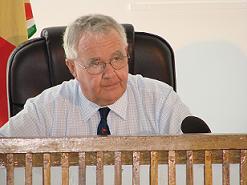
Before doing so, Judge Reilly made a statement at National House before interested parties and representatives of the local media, in which he noted that the inquiry was set up on January 19, 2007 by an instrument of appointment signed by President James Michel, and therefore, it had its origin in this country and nowhere else.
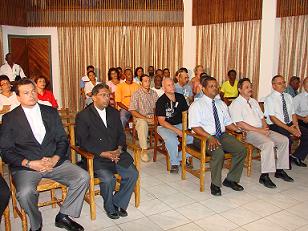
“He said that the very fact that the inquiry was set up was in itself of great significance because it showed that the Seychelles’ Government was concerned about the events, which occurred outside the National Assembly on October 3, 2006.
“Furthermore, the fact that it asked another government – the Irish Government – to nominate one of its judges to carry out an independent inquiry showed a commitment and willingness to establish the truth about what happened on that day,” he said, adding that those facts need to be recognised and due credit given to the Seychelles Government for doing so.
Judge Reilly said that the inquiry’s opening statement delivered on March 19 this year drew attention to the fact that the terms of reference of the inquiry had been the outcome of consultations involving representatives of the government and the main opposition political party, the Seychelles National Party (SNP).
“The fact that the terms of reference finally given to the inquiry were acceptable to both the government and the SNP operation required of them to enable the inquiry to do its work. We believed that was achieved and we thank all the people involved,” he said, noting that the inquiry’s investigators took approximately 170 statements from potential witnesses and then considered those statements and decided which witnesses should be called to give oral evidence to the inquiry.
Mr Reilly said that in order to avoid unnecessary duplication of evidence and in the interest of efficiency, just 80 or so witnesses were called to give evidence and that in drafting the report, the inquiry adopted the approach that it would not produce blueprints for change relating to all aspects of its terms of reference.
“Rather we took the view, in the main, that we would suggest pointers for reform and leave the details to those charged with the responsibility of implementing the recommendations which we make in the report. We took this view simply because we believed that the people of the Seychelles and their leaders are the best people to decide what is appropriate for Seychelles society.”
He said that the report bears criticism and, “indeed, pain for some people.”
He hastened to add that the inquiry took no pleasure in this aspect of the report but not to have been honest and forthright in its findings and recommendations would have been not only to debase the inquiry itself but to do a great disservice to the people who set up the inquiry and, indeed, to the people of Seychelles.
“We cannot, of course, give any of the details of the contents of the report here this morning. The responsibility of the inquiry is to the President.
“It is entirely a matter for the President to decide whether or not to publish the report,” the judge said.
He said that while in the Seychelles he and his team received nothing but the greatest courtesy, not just from the people directly involved with the inquiry but from everybody they met.
“It would be ungracious of us to suggest that during our stays here it was all hard work and no pleasure. The team thoroughly enjoyed coming here and working in your beautiful country,” he said, thanking the principal secretary for Presidential Affairs, Jean-Paul Adam, for looking after the logistics, the master and registrar of the Supreme Court, Melchior Vidot, for organizing the hearings and chief court interpreter Alex Larue for translating Creole proceedings into English.