


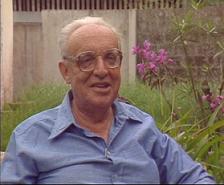
Guy Lionnet, populariser of Seychellois natural history-by Pat Matyot |10 December 2007
A“What’s this great smell?” he asked. “A rare orchid or som

Xavier reached out and pulled one of the branches gently towards him. At the end was a mass of long-tubed flowers ranging from near-white to deep red in colour. He moved his face nearer to them and sniffed again. “Named after old man Lionnet, I presume?”
“Hey, you’re getting addicted to the scent!” I teased. “Yes, it bears the name of Guy Lionnet, complete with G for Guy at the beginning.”
On November 30th, Geneviève Lionnet called to tell me her father had passed away at the age of 85. That evening I looked up the scientific paper published in 1984 in which the Mauritian botanist Deva Duttun Tirvengadum, a former director of the Mauritius Institute,
«Le genre est nommé Glionnetia, wrote Tirvengadum, en l’honneur de M. Guy Lionnet, ancien Directeur du Département de l’Agriculture des Seychelles, pour ses efforts en vue de vulgariser les sciences naturelles dans cet archipel. Je lui dois en particulier de m’avoir organisé une visite au Morne Seychellois National Park pour étudier ce nouveau genre dans la nature.» Lionnet had arranged for Tirvengadum to be accompanied by one of the best guides around, Lindsay Chong-Seng, currently Science Coordinator of the Seychelles Islands Foundation (SIF).
Vulgarisateur
That description of Guy was so right, I thought. He had not carried out much original research on the flora and fauna of Seychelles, but he had been instrumental as a vulgarisateur, a populariser, who had scoured the scientific literature and re-written with infectious enthusiasm about the plants and animals of Seychelles, with the aim of making the information more readily accessible to non-scientists. This fitted well with his other love, that of books: «La lecture, c’est mon vice!» he once confided.
His Romance of a palm: coco de mer, first published in 1970, has been through five editions. The Seychelles, published in 1972 in the Islands series by David & Charles (Great Britain) contained a whole 17-page chapter devoted to natural history, in which Guy referred to mangliye gran bwa - not yet named Glionnetia - as being “reputed to bear the most beautiful indigenous flower of the Seychelles”. Leafing through my copy of the book again a few days after Guy’s death I was quite startled to see this prophetic last line on page 176: “Their future hopes of prosperity probably lie in the field of tourism, though the character of the Seychelles may be changed in the development process – to the regret of many who were born in the islands.”
For Guy, popularising the scientific knowledge regarding Seychellois natural history was a way of mustering support for conserving the unique biodiversity of the islands. His appointment as Chairman of the Seychelles Islands Foundation (SIF) in the 1980s was a fitting one, because at the end of the 1960s he had taken part in the campaign to prevent the construction of an Anglo-American military base on Aldabra.
In his book Aldabra Alone, the British wildlife documentary-maker Tony Beamish described his first meeting with Guy in Mombasa (Kenya) in February 1967, at the start of an expedition to the atoll: “Next day, as I was marking my map with new information, there came a knock at the door and in walked a stocky fair-haired man. It was Lionnet, the leader of our expedition… The soft-spoken government servant, equally at home in French and English… had only once before been to Aldabra and then only for a fleeting look at Settlement Island (Ile Picard)… Guy Lionnet had been Director of Agriculture and Fisheries in the Seychelles for many years. As an official of the government he had to speak guardedly about the plans for Aldabra. As we chatted over a glass of iced East African beer, and laughed at the story of the land crab attacking the man from the (British) Defence Ministry, I tried to detect in his humorous face his own feelings about saving Aldabra from the destruction that threatened it. Although he was obviously the type who would want to see for himself first, I got the impression, not so much from what he said as what he omitted to say, that he would prove to be a champion in the atoll’s defence. And it turned out to be correct.”
Passion
Back on Mahé, Guy went on Radio Seychelles to explain with passion why Aldabra should be spared from destruction. In the Seychelles Bulletin of March 29th 1967 he wrote: “ Virtually unspoilt by man, Aldabra is a virgin land where plants and animals exist in a natural but fragile equilibrium. This could easily be upset by man and his machines. To preserve and protect (it), so that our children’s children may enjoy it, Aldabra should be left to itself. It should be turned into a sanctuary, untouched and untouchable. It deserves no less.”
I was on Aldabra last month for the annual general meeting of the SIF Board of Trustees, which had been timed to coincide with the 25th anniversary of Aldabra as a World Heritage Site. A week earlier the Island Conservation Society (ICS) had held its AGM on D’Arros. At both meetings, we considered plans for 2008: what new scientific research to carry out to better understand how our island ecosystems work, how to keep away alien invasive species, how to rehabilitate native vegetation… Guy left us before we got the chance to talk to him about our latest projects. But I know he would be happy to see that the SIF, the ICS, the Ministry of Environment and other organisations continue to press for conservation to remain a top national priority, he who spoke so passionately about the trésors d’histoire naturelle of Seychelles.