


Grow your own fruit trees – even if you live in a flat |21 February 2009
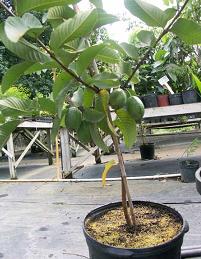
However, there are ways to get round this problem to ensure you too can benefit from your
It is a little-known fact that such fruits as passion fruit, guava and pineapple can be grown in containers as they are shrubs or small trees. Citrus trees such as orange, lime and mandarin also do especially well in containers.
Guava, for instance, is known to be one of the few fruit trees that can grow to fruiting size in containers. It is rich in vitamins A and C – a single guava has four times the vitamin C of an orange – as well as containing extremely high levels of fibre, qualities that classify it as a super fruit.
In certain regions of the world guava leaves are used as a remedy against diarrhoea, while the bark is used to treat diabetes.
Scientists are also testing certain extracts from the plant to determine whether they can be used to treat cancer, as well as bacterial infections, inflammation and certain pains. Locally the fruit is usually eaten raw or in fruit juices.
Planting fruit trees in containers can be a particularly good idea for people living in flats, without access to large plots of land to cultivate. It is also so much easier to pick fruit from trees grown in containers as they remain small.
However, containers used to grow such trees should be at least 60cm in diameter; using a barrel that has been cut in half is very handy.
As with all containers used for planting, they should have holes drilled at the bottom to allow drainage.
First, you must place some decomposed coconut husk at the bottom of the container, followed by a layer of dolomite in red soil only. The top of the container should have a layer of decomposed manure and then topsoil must be added as it is rich in organic matter and humus debris. Topsoil is found in the uppermost soil layer.
Once the soil is ready, make a hole in the middle of the container to put your selected plant in.
Anyone using plants bought in plastic bags filled with soil must water the plant before cutting away the bag and make sure the earth is water-soaked.
Cut the plastic bag first in a circle at the bottom then on one side, all the while taking extra care not to damage the roots.
Place your plant in the middle of the hole and cover with soil, surrounding it with plenty of dried grass to ensure it stays moist.
After planting the fruit tree, it is very important to water it twice a week and weed it regularly.
Fertiliser must also be applied to the trees twice a year, in the period between March and April as well as October and November.
It must be noted that although fruit trees planted in containers will bear fruit, they will not produce as much as those planted in the ground.
Planting in the ground
More or less the same process must be followed for planting fruit trees in the ground, although there the best soil is red or alluvial soil, sandy soil or gravel soil.
For fruits such as mango, citrus and avocado, the hole should be about 50cm deep by 80cm wide. Pawpaw on the other hand needs a 40cm by 40cm hole.
Then put in decomposed coconut husk at the base of the hole, followed by some manure on top of that.
Again the same maintenance routine should be followed as with the potted plants, the only difference being that herbicides such as Round-up can be used, in addition to weeding with a hoe.