


Tackling climate change through standards |10 October 2009

To coincide with the event, the Seychelles Bureau of Standards (SBS) has sent the following feature which says we all have a role to play in slowing down climate change.
Climate change
“2009 must be a year of ACTION on climate change...The cost of acting to reduce climate change is far less than proceeding on the same route we are currently stuck in...Let us act, let us act now, let us stand before our people and make a promise on behalf of humanity – a promise to save our coast, save our islands – to save our world.”
These were the words of President James Michel while addressing the UN Summit on Climate Change held in New York on September 22.
The Intergovernmental Panel on Climate Change (IPPC) has also warned in its fourth assessment report that climate change may bring “abrupt and irreversible” global impacts, and highlights the challenges that await humanity in the future, including water shortages, increased risk of floods, erosion, storm surges and much more. The report raises serious concern over the anticipated rise in sea levels, melting of glaciers and extinction of numerous species around the world.
Everyone seems to have finally accepted the critical importance of climate change. Preoccupation with the issue is no longer limited to the governments’ environmental bodies and leaders in science and industry. According to a survey by Consumers International, two-thirds of consumers agree that everyone needs to accept responsibility for their personal contribution to global warming.
The year 2009 is, therefore, a crucial year in the international effort to address climate change, culminating in the United Nations Climate Change Conference in Copenhagen, Denmark, in December. The purpose: to forge a new climate treaty to replace the Kyoto Protocol.
World Standards Day 2009
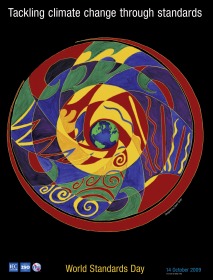
Every year these international standards bodies promote a particular theme to raise awareness of the importance of global standardisation to the world economy and to promote its role in helping meet the needs of business, industry, government and consumers worldwide.
This year’s theme is Tackling Climate Change through Standards.
The ISO is the leading multi-stakeholder, multi-sector, multi-national platform for developing consensus-based international standards. The organisation is a network of national standards bodies from 160 countries in all regions of the world. The SBS is a corresponding member of this international organisation.
ISO, the environment and climate change
Out of a total of over 18,000 ISO standards and related documents, more than 570 are directly related to environmental change, and many more can help in reducing environmental impact.
Offering businesses, government and society a complete portfolio of practical tools for tackling environmental challenges, they range from standards for sampling, testing and analytical methods, through environmental management and environmental aspects of product design, to new work on ship recycling.
ISO standards directly related to climate change include ISO 14067 – now under development, for measuring the carbon footprint of products. Targeted for publication in 2011, it will complement the already published standards ISO 14064:2006 and ISO 14065:2007, which provide an internationally agreed framework for measuring greenhouse gas (GHG) emissions, verifying claims made about them and accrediting the bodies which carry out such activities.
ISO standards offer practical tools for addressing climate change at four levels.
1. Monitoring climate change
The ISO technical committee ISO/TC 211 develops standards on geographic information and geomatics, which help to measure the extent of the effects of climate change. The ISO is also collaborating with the Food and Agriculture Organisation of the United Nations (FAO) and the World Meteorological Organisation (WMO) to develop further standards for gauging essential climate change variables.
2. Quantifying GHG emissions and communicating on environmental impacts
Quantifying
ISO 14064 and ISO 14065 provide an internationally agreed framework for measuring GHG emissions and verifying claims made about them so that “a tonne of carbon is always a tonne of carbon”. They thus support programmes to reduce GHG emissions and also emissions trading programmes. ISO 14064 is emerging as the global benchmark on which to base such programmes.
ISO 14064 is consistent and compatible with the GHG Protocol, published by the World Resources Institute (WRI) and the World Business Council for Sustainable Development (WBCSD).
The ISO, the WRI and the WBCSD have signed a memorandum of understanding to work together to promote their GHG accounting reporting standards.
The Voluntary Carbon Standard (VCS) developed by the Climate Group (TCG), the International Emissions Trading Association (IETA) and the World Business Council for Sustainable Development (WBCSD) specifically integrates the principles of ISO 14064 and uses the validation and verification requirements of ISO 14065.
Achieving international agreement on the quantification and verification of emissions trading is the key to supporting the development, networking and consistency of emission credit trading schemes.
Communicating
The ISO has developed a number of standards to ensure good practice in environmental claims and communications.
• ISO 14020:2000, Environmental labels and declaration;
• ISO 14063:2006, Environmental communication;
• ISO 21930:2007, Sustainability in building construction – environmental declaration of building products.
3. Promoting good practice in environmental management and design
The ISO 14000 family of standards for environmental management developed by ISO technical committee ISO/TC 207 is firmly established as the global benchmark for good practice in this area.
ISO 14001:2004, Environmental management systems – requirements with guidance for use, contributes to any organisation’s objectives to operate in an environmentally sustainable manner.
Up to the end of December 2007, more than 154,000 ISO 14001 certificates of conformity had been issued to private and public sector organisations in 148 countries and economies.
The ISO 14000 family includes supporting tools for environmental management and designing environmentally friendly products and services.
• ISO 14004:2004, Environmental management systems – general guidelines on principles, systems and support techniques;
• ISO 14040:2000, Environmental management – lifecycle analysis – principles and framework for lifecycle analysis;
• ISO Guide 64:2008, Guide for addressing environmental issues in product standards.
4. Opening world markets for GHG emissions reduction and trading, and energy efficient technologies
International standards can also make essential contributions to realising the full potential of energy efficiency measures based on existing technology and good practice, as well as to disseminating innovative technologies – particularly for renewable and carbon-neutral energy sources.
In the case of innovative technologies, standards can reduce the time to market the products and services based on them, create global interest and develop a critical mass of support to ensure the economic success of such technologies.
ISO standards are among the leading objective tools that help policy-makers in decisions related to public incentives, thus encouraging the judicious and widespread use of such innovative technologies.
The ISO has already developed standards with an impact on climate change for areas such as building environment design, energy efficiency of buildings and sustainability in building construction, intelligent transport systems, solar energy, wind turbines, nuclear energy and hydrogen technologies.
The ISO’s proactive stance on energy and climate change matters has resulted in the initiation of ISO work on energy management systems (the future of ISO 50001) and the examination of new opportunities in energy efficiency and renewable energy sources.
The ISO maintains its cooperation with the International Electro-technical Committee (IEC) and has also partnered with the International Energy Agency (IEA) and the World Energy Council (WEC) in joint initiatives related to this field. In March 2009, the ISO jointly organised a workshop in Paris with the IEA and IEC on International standards to promote energy efficiency and reduce carbon emissions.
Energy efficiency in buildings
The world is facing unprecedented energy challenges resulting from increased concern over supplies of fossil fuels and clearly discernable climate changes. Energy consumption in buildings represents close to 40% of the world’s total energy use (Source:
www.iea.org/g8/2008/Building_Codes.pdf), including climate control and energy used for appliances, lighting and other installed equipment.
There are many ways to reduce the energy requirements in buildings. The potential saving from energy efficiency in the building sector would contribute substantially to a worldwide reduction in energy consumption.
Various ISO technical committees have been active in the field of energy in buildings, each from different perspectives. This is particular true for ISO technical committee ISO/TC 163, Thermal performances and energy use in built environment, and ISO/TC 205, Building environment design. These two TCs have now joined forces to set up a joint working group aimed at fostering a smooth and rapid development of energy efficiency standards for the global building industry.
Examples of standards on thermal performance:
ISO 6946:2007, Building components and building elements – thermal resistance and thermal transmittance – calculation method;
ISO 13789:2007, Thermal performance of buildings – transmission and ventilation heat transfer coefficients – calculation method;
ISO 13370:2007, Thermal performance of buildings – heat transfer via the ground –calculation methods;
ISO 10211:2007, Thermal bridges in building construction – heat flows and surface temperatures – detailed calculations;
Part 1 and 2 of ISO 10077 published under the general title, Thermal performance for windows, doors and shutters – calculation of thermal transmittance.
Examples of standards on building environment design
ISO 16813:2006, Building environment design – indoor environment – general principle;
ISO 16818:2008, Building environment design – energy efficiency – terminology;
ISO 16814:2008, Building environment design – indoor air quality – methods of expressing the quality of indoor air for human occupancy;
ISO 23045:2008, Building environment design – guidelines to assess energy efficiency of new buildings.
Future ISO 50001 for energy management systems
The ISO is known for its world-famous suite of management system standards for quality (ISO 9000 series) and the environment (ISO 14000 series) respectively. Both have successfully stimulated substantial, continual efficiency improvements within organisations around the globe.
Stakeholders are now experiencing an interesting nexus of the need for effective energy management and the successful growth of international, consensus-based management system standards.
Therefore, it is clear the time has come for an energy management system standard. Effective energy management is a priority focus not only because of the significant potential to save energy, but also because of its role in reducing GHG emissions worldwide.
The ISO has identified energy management as one the top five areas requiring the development and promotion of international standards.
This need did not go unnoticed in several countries, with initiatives underway in China, Ireland, the Republic of Korea, the USA and the European Union with its EN 16001.
And clearly, the first major users of such a standard will be industry. The expected benefits of the future standard are numerous, including major, long-term increases in energy efficiency of more than 20% in industrial facilities.
The standard will provide organisations and companies with technical and management strategies to increase energy efficiency, reduce costs and improve environmental performance. Based on broad applicability across national economic sectors, the future standard could influence up to 60% of the world’s energy demand.
Although originally intended for industry, the standard will apply to any type of organisation wishing to effectively manage its energy uses and efficiency.
The future of ISO 50001 will establish an international framework for industrial and commercial facilities, or other types of organisations, such as public sector operations, to manage all aspects of energy, including procurement and use. As with the ISO 9000 and the ISO 14000 series, it is likely that there will be a certification process for ISO 50001 to certify the management system itself.
Examples of GHG international standards
First published by the ISO in 2006, ISO 14064 comprises three standards detailing specifications and guidance for the organisational and project level, and for validation and verification. They can be used independently, or as an integrated set of tools to meet the varied need of GHG accounting and verification. They are:
ISO 14064:2006 – Greenhouse gases – part 1: Specification with guidance at organisation level for the quantification and reporting of greenhouse gas emissions and removal specifies verifiable requirements for organisations to design, develop, maintain and report on emissions through inventories, and deals with quantifying GHG emissions through monitoring and reporting programmes.
ISO 14064 -2: 2006 – Greenhouse gases – part 2: Specification with guidance at project level for the quantification, monitoring and reporting of greenhouse gas emissions reduction or removal enhancements specifies verifiable requirements for GHG project proponents to plan, monitor, quantify and report on projects, including resultant GHG emission reduction or removal enhancement units.
This is useful for proponents of voluntary projects, regulatory credit-based schemes and government administrators designing programmes and schemes.
ISO 14064 -3: 2006 – Greenhouse gases – part 3: Specification with guidance for validation and verification of greenhouse gas assertions specifies verifiable requirements for validation/verification bodies and validators/verifiers in proving assurance of GHG claims from organisations using parts 1 and 2 of the standards. The part 3 standard aims to be applicable to any GHG scheme and will be of interest to validation/verification bodies, validators/verifiers and GHG scheme administrators.
ISO 14065: 2007 – Greenhouse gases – requirements for greenhouse gas validation and verification bodies for use in accreditation or other forms of recognition. This standard establishes the requirements that allow accreditation bodies and others to assess the process used, and credibility of GHG verifiers and validators.
It provides an internationally agreed framework for measuring GHG emissions and verifying claims made about them so that “a tonne of carbon is always a tonne of carbon”. They thus support programmes to reduce GHG emissions and also emissions trading programmes. ISO 14064 is emerging as the global benchmark on which to base such programmes.
Carbon footprint standard moves forward
The substantial international involvement and response to the draft ISO 14067 – Carbon footprint of products, is a clear sign of the growing interest of companies worldwide on greenhouse gas quantification. Carbon footprint (CFP) refers to the impact that we have on the environment. It involves the calculation of the GHG emissions associated with a company, event, activity, or lifecycle of a product or services. CFP is therefore a powerful tool for decarbonising the product supply chain.
CFP enables GHG emissions along the supply chain to be ascertained and managed. It therefore allows comparison of CFP values between different products, between the same products from different producers, and between the same products from the same producer in different locations. In this way, it safeguards the survival of companies in the changing regulatory and economic business landscape.
ISO 14067 will include the principle of modularity. The aim is for ISO 14067 to become a user-friendly tool, which should help users not only to make strategic decisions (for example on product design), but also day-to-day operational decisions to reduce GHG emissions along the supply chain.
This standard is expected to play a key role in meeting the medium and long-term global goals agreed under international processes such as the G-8 and G-20 Summits, and under the United Nations Framework Convention on Climate Change outcome in Copenhagen.
Renewable energies to feed global appetite for electricity
According to the IEA, World Energy Outlook 2008, modern renewable energy technologies will grow most rapidly in the year ahead, overtaking gas to become the second-largest source of electricity behind coal, soon after 2010.
It is against this backdrop that the IEC (International Electro-technical Commission) is working to set international standards that can serve this market.
Wind has been the fastest growing renewable electricity source worldwide with an average annual growth rate of 24% over the period 1990-2005 according to the IEA.
The IEC technical committee IEC/TC88, Wind Turbines, prepares standards that deal with safety, measurement techniques and test procedures for wind turbine generator systems. It has produced standards for design requirements, acoustic noise measurement techniques, measurement of mechanical loads, and communication for monitoring and control of wind power plants.
The IEC technical committee IEC/TC 4, Hydraulic turbines, prepares standards and technical reports for designing, manufacturing, commissioning, testing and operating hydraulic machines. These include turbines, storage pumps and pump turbines of all types as well as speed governors and performance evaluation and testing.
In response to calls from the market, including the IEA, the IEC created a technical committee IEC/TC 114, Marine Energy – wave, tidal and other current converters to begin preparing standards for this emerging field.
The market for photovoltaic (PV) power application is expanding rapidly in developed and developing countries alike. As its uses have multiplied and industry has grown, PV has proved to be one of the most reliable sources of electricity. IEC/TC 82, Solar Photovoltaic energy systems prepares international standards for all elements of those systems – everything from light inputs to PV cells to the interface with the system to which the electrical energy is supplied.
The technical committee ISO/TC 180, Solar energy, has so far published 16 standards dealing with solar thermal energy systems (or solar heating and cooling, also known as SHC). The solar market is evolving, creating new challenges that need to be addressed by the ISO. A high priority area identified by the ISO Strategy Advisory Group on Energy (SAGE) concerns the development of new international standards to better support the integration of solar devices in buildings and their maintenance.
The development of geothermal power encompasses a variety of activities similar to those of the oil and gas industry (exploration, well-drilling, plant construction etc). While no ISO committee is specifically covering geothermal power energy issues, the matter is currently under discussion at the ISO SAGE and new development in this field may be recommended.
Bioenergy refers to renewable energy derived from biomass – i.e. organic material grown, collected or harvested for energy use (to generate electricity or heat). The conversion products derived from biomass are known as biofuels (liquid and solid) and biogas.
According to the IEA, bioenergy is the largest renewable energy contributor – accounting for about 10% of the current global primary energy consumption – and has the highest potential of all renewable sources.
Bioenergy is used for:-
● Cooking and space heating in households (primarily in developing countries), which currently accounts for about two-thirds of the demand;
● Transport (through biofuels – bioethanol and biodiesel);
● Power generation (through different combustion technologies).
In response to these development and trends, the ISO has taken a number of initiatives, notably the establishment of ISO/TC 238, Solid biofuels, to deal with a variety of aspects such as terminology, fuel specification and classification and test methods.
Finally, the ISO SAGE is investigating standardisation needs in the combined heat and power field, and new ISO development may be recommended.
For further information about international standards, contact the Seychelles Bureau of Standards (SBS), Standards House, Providence Industrial Estate. Tel: 380400/380405.
Fax: 373826. Email: sbsorg@seychelles.net
National activities for World Standards Day 2009
To commemorate World Standards Day, the Seychelles Bureau of Standards (SBS) will be organising a half-day seminar for stakeholders on Wednesday October 14. Various presentations will be given in relation to the theme Tackling Climate Change Through Standards. The half-day seminar will be held at National Institute of Education, Mont Fleuri, from 9.30am-11.55am.
A poster competition has also been organised for primary and secondary schools with the help of the Ministry of Education.