


Parliament – the mirror of a nation-V. Sivasupramaniam |16 January 2010

When Seychelles was a British colony, it had a legislative council system imposed from above rather than elected by the people. The evolution gained speed after independence in 1976, and from 1993 after the Third Republic a truly representative parliament in Seychelles was established and has come to be known as the National Assembly of Seychelles.
The new parliamentary complex stands as a national pride, where rich and noble parliamentary traditions are to be evolved.
Parliament is the seat of authority and of good governance from where all welfare measures for the good of the country and the people emanate. It is the ultimate body for the ventilation of all the grievances of the people through their elected representatives.
The word parliament comes from a French word “parlement”, which signifies a place of speaking. Parliament, therefore, is essentially a place of speaking.
It is the forum for discussion and debate of all national issues and solutions reached in the national interest. It is a dignified institution where the highest standards of debate and decorum are maintained and a model for all other institutions to follow.
Its members enjoy certain privileges, and the statements and opinions expressed in the house are made with great responsibility and seriousness and cannot be questioned. The speaker of the house, an impartial figure, upholds the rights of the members, and the dignity and the balance of the house.
Parliament, the legislative body, is one of the three arms of state – the legislature, the executive and the judiciary.
The legislature is responsible for enacting laws, the executive for carrying out the laws passed by the legislature, and the judiciary, an independent and impartial body, interprets the laws.
The parliamentary system that prevails in many countries of the world is mostly modelled on the British parliamentary system, which goes back to Anglo-Saxon times beyond the 11th and 12th centuries. Most countries have made certain adjustments to suit their own needs.
It may be of interest to note that Britain does not have a written constitution, like many other countries of the world, but all parliamentary practices are based on conventions and traditions which are religiously upheld in the working of parliamentary democracy.
There are many written laws such as the Magna Carta of 1215 and the Bill of Rights of 1688 that ensure the rights and dignity of its people, but the conventions have stronger validity and acceptance than written laws.
For example, when the government is defeated in parliament on a policy matter, the government automatically resigns – it is a strong convention but there is no law to that effect.
Parliaments are organised in two different patterns. One is unicameral (single-chamber) and the other is bicameral (double-chamber). This may vary according to the needs and desires of each country.
Normally, small countries with small populations prefer unicameral legislature. Seychelles is a good example of such a country.
Bicameral legislatures are necessary for countries with a large area or population to give representation to different states, diverse ethnic, linguistic and religious groups. In countries that have a federal system of government, a system of bicameral legislature serves all their interests in a better way.
Usually, parliaments are elected once in five years, by universal adult suffrage – all adult citizens over 18 years of age (earlier 21 years ) having the right to vote. Periodic elections are fundamental to the success of democracy.
Single-chamber assembly
Seychelles has a single-chamber legislature – National Assembly – periodically elected by the people. Each of the 25 districts elects its member of the National Assembly (MNA) who, plus seven others elected on a proportional system – membership allocated in proportion to the number of votes polled by the different political parties – form the assembly.
One among them is elected the speaker of the assembly, who after being elected to the chair becomes an independent person and is the custodian of the house and the upholder of the rights of the assembly members.
It is appropriate to compare the structure of the parliamentary system in some other countries and the duties performed by the parliament for the good of the people. Examples cited are of Britain, the USA, France, India, Australia, Singapore, South Africa and Mauritius.
Apart from the national parliaments, the latest institution is the regional parliament of many of the European countries, called the European Parliament.
BRITAIN:
The British parliament is considered the mother of parliaments. It has a long and rich tradition. King John’s Magna Carta in 1215, initiating the evolution of the English parliament out of the Curia Regis of the Norman kings, secured for the English people the Petition of Rights, the Habeas Corpus Act and the Bill of Rights.

The principles as laid down in the Magna Carta were the impetus given to the development of the English parliament. The 13th century saw the introduction of the elective system in determining membership of the Curia Regis.
It was the extension of this system that was to turn the Curia Regis into the English parliament, to play a leading part in preserving English liberties and finally to result in the development of the system of representative government that has been the greatest political contribution made to the world by the Anglo-Saxons.
The elective principle was occasionally used as early as the reign of King John for the purpose of choosing representatives of the royal demesnes and of the lesser barons. It was not, however, until the time of Simon De Montfort and the parliament of 1265 that the principle was used to secure representation for the cities and boroughs.
Edward I’s parliament of 1295 stands as a landmark in the constitutional and political history of England.
The Parliament of the United Kingdom of Great Britain and Northern Ireland is the supreme legislative body in the UK and British overseas territories. Parliament alone has parliamentary sovereignty and thereby ultimate power over all other political bodies in the UK and its territories.
At its head is the sovereign, Queen Elizabeth II. The parliament is bicameral, with an upper house, the House of Lords, and a lower house, the House of Commons. The Queen is the third component of the legislature.
The House of Lords includes two different types of members: the Lords Spiritual (the senior bishops of the Church of England) and the Lords Temporal (members of the peerage) whose members are not elected by the population at large but are appointed by the sovereign on the advice of the prime minister.
The total membership stands at 740 peers. Before the opening of the Supreme Court in October 2009, the House of Lords also performed a judicial role through the Law Lords.
The House of Commons,with a membership of 646, is a democratically elected chamber with elections to it held at least every five years.
THE USA:
The United States Congress is the bicameral legislature of the federal government of the USA, consisting of two houses – the Senate and the House of Representatives. Both senators and representatives are chosen by direct election.

Each of the 435 members of the House of Representatives represents a district and serves a two-year term. House seats are apportioned among the states by population.
The 100 senators serve staggered six-year terms. Each state has two senators, regardless of population. Every two years, around a third of the Senate is elected at one time. Re-election rates for incumbents often exceed 90%.
The House and Senate are equal partners in the legislative process (legislation cannot be enacted without the consent of both chambers); however, the Constitution grants each chamber some unique powers.
The Senate is uniquely empowered to ratify treaties and to approve top presidential appointments. Revenue-raising bills must originate in the House of Representatives, which also has the sole power of impeachment, while the Senate has the sole power to try impeachment cases.
FRANCE:
The French National Assembly (French: Assemblée nationale) is the lower house of the bicameral Parliament of France under the Fifth Republic. The other is the Senate (Sénat). The National Assembly consists of 577 members known as députés (deputies), each elected by a single-member constituency. Deputies are elected in each constituency through a two-rounds system, with 289 seats required for a majority. The term of the National Assembly is five years.

Senators are elected indirectly by about 150,000 local elected officials ("grands électeurs"), including regional councillors, department councillors, mayors, city councillors and their delegates in large towns, and deputies of the National Assembly.
This system introduces a bias in the composition of the Senate that favours rural areas. As a consequence, while the political majority changes frequently in the National Assembly, the Senate has remained politically conservative. Twelve senators are elected to represent French citizens living outside the country.
Until September 2004, the Senate had 321 senators, each elected for a nine-year term. On that date, the term was reduced to six years, while the number of senators will progressively increase to 346 in 2010 to reflect changes in the country's demographics. Senators were elected in thirds every three years; this will also change to one half of their number every three years.
INDIA:
The country has a bicameral parliament including the Rajya Sabha (Council of States) and the Lok Sabha (House of the People).
LokSabha
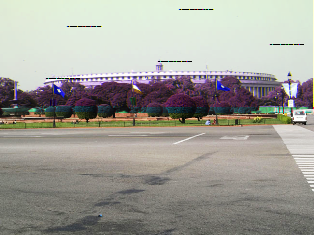
The Lok Sabha is composed of representatives of the people chosen by direct election on the basis of universal adult suffrage. As of today, the Lok Sabha has 545 members with two members nominated by the president to represent the Anglo-Indian community. Unless dissolved under unusual circumstances, the term of the Lok Sabha is five years, and it elects its own presiding officer, the speaker.
Rajya Sabha
The Rajya Sabha consists of 245 members. Of these, 233 represent states and union territories and 12 are nominated by the president. Elections to the Rajya Sabha are indirect; members are elected by the elected members of legislative assemblies of the concerned states. The Rajya Sabha is not subject to dissolution, one third of its members retire every second year.
The allotted quota of the representatives of each state are elected by the members of the legislative assembly of that state in accordance with the system of proportional representation by means of a single transferable vote.
The nominated members are people with special knowledge or practical experience in literature, science, arts and social service. The Rajya Sabha is presided over by the vice-president of India.
AUSTRALIA
Australia, a federal nation with six states, has a bicameral legislature.
The House of Representatives is the lower house of the Australian parliament. Currently composed of 150 representatives elected from single-member constituencies, the House decides which party shall govern and is the focal point of political debate and conflict.
The Australian Senate is one of the most powerful upper houses of any parliament in the world. With equal representation of the states and a proportional voting system that allows minority parties to win seats, the Senate is rarely controlled by the government or the opposition.
SOUTH AFRICA
South Africa has a bicameral legislature. The parliament of South Africa is the country’s legislature and is composed of the National Assembly and the National Council of Provinces. Under the 1994 Constitution, the parliament – consisting of a Senate and a National Assembly – was also the “constitution-making body”.
Under the 1997 Constitution, the Senate, elected by members of each of the nine provincial legislatures, was replaced by a National Council of Provinces, which retained the former Senate’s membership but changed its legislative and constitutional role. The National Assembly remained unchanged as the primary legislative chamber, with the president of South Africa being the leader of the largest party in that house.
SINGAPORE
The parliament of the Republic of Singapore and the president jointly make up the legislature of Singapore. Parliament is unicameral and is made up of Members of Parliament (MPs) who are elected, as well as Non-constituency Members of Parliament (NCMPs) and Nominated Members of Parliament (NMPs), who are appointed.
Following the 2006 general election, 84 MPs were elected, and one NCMP and nine NMPs were appointed.
In the 1959 general elections, the People’s Action Party (PAP) swept to power, and Lee Kuan Yew was named the first Prime Minister of Singapore. Singapore gained independence from Britain by joining the Federation of Malaysia in 1963 but became a fully independent republic on August 9, 1965. Its Legislative Assembly was renamed the Parliament of Singapore.
MAURITIUS
The parliament
The Constitution of Mauritius provides for the parliament to consist of the president and the National Assembly. The parliament is modelled on the Westminster system of parliamentary democracy where Members of Parliament are voted in at regular general elections, on the basis of a first-past-the-post system.
The National Assembly
The assembly is made up of 70 members of whom 62 are directly elected in 21 constituencies. The island of Mauritius is divided into 20 constituencies returning three members each, while Rodrigues is a single constituency returning two members.
After a general election, the Electoral Supervisory Commission may nominate up to a maximum of eight extra members in accordance with section 5 of the first schedule of the Constitution with a view to correct any imbalance in community representation in parliament. This system of nominating members is commonly called the best loser system.
THE EUROPEAN PARLIAMENT
The European Parliament (EP) is elected by the citizens of the European Union to represent their interests. Its origins go back to the 1950s and the founding treaties, and since 1979 its members have been directly elected by the people they represent.
Elections are held every five years, and every EU citizen is entitled to vote and to stand as a candidate, wherever they live in the EU. The latest elections were in June 2009. Parliament thus expresses the democratic will of the union's citizens (more than 490 million people) and represents their interests in discussions with the other EU institutions.
The present parliament has 736 members from all 27 EU countries. Jerzy Buzek was elected President of the EP on July 14, 2009 and will hold that post for 2½ years until January 2012.
MODERN DEMOCRACY
In any modern democratic country, parliament is the national forum where any matter of national importance is brought up, discussed and debated. Finally, appropriate laws are drawn up to be enforced by the state machinery through the country’s executive.
From among the many issues brought up, two outstanding ones are taken up by any parliament in the world as they are common to all, and very important too. One is the policy statement of the government of the day and the other is the budget for the year. If any government is defeated in either of the two, it is an accepted convention for it to go out of office.
The policy statement of the government is an annual event when the government of the day presents to the people, through the parliament, its achievements in the past year and the new measures to be carried out in the following year.
This can be done in different ways in different countries. In Britain it is the throne speech delivered in the House of Commons by the Queen, who is the de jure head of the nation while the ruling party bears the de facto responsibility for government policy. In the USA it is the address to the nation by the president in a joint session of both the houses.
In Seychelles it is the address to the nation in the National Assembly by the President of the Republic, which is an annual event. This is the best opportunity for all the members in the parliament to appreciate, criticise, discuss and also to suggest new ways to improve the conditions of the people and the country, since all the members have the chance to speak.
The debate continues for a longer period, and finally the house gives its approval for the policy of the government.
The other important issue is the annual budget, which is considered vital for the country as it involves money matters. The budget is normally presented by the finance minister, and in Britain it is presented by the Chancellor of the Exchequer.
The budget enumerates all the new measures and taxes that are to be introduced to generate more revenue for the country and also all details of expenditure to be incurred in the following year.
The budget debates generate a lot of heat and fire in the parliament as every member would like to get a bigger slice for his constituency while at the same time trying to lessen the tax burden on the people.
It is also an opportunity for members to ventilate their grievances because they have the chance to speak on any matter concerning the people.
Apart from these two important issues, parliament serves as a mirror of the nation. The will of the people can be reflected in many ways in parliament. Bills can be brought in by private members for the enactment of laws, apart from government Bills.
During question time, any matters of importance can be raised by any member of the house. These can be oral questions or written questions, for which adequate notice should be given. During adjournment of the house, matters of grave importance can be raised by any member. During important debates like the budget or the president’s address to the nation, the right to reply is given first to the leader of the opposition.
The Youth Parliament
This new system – introduced in Seychelles to expose young people to parliamentary practices early in life – augurs well for building strong democratic values in the youth of Seychelles and should be encouraged by society.
Parliament is the sacred institution for any country. It is the pride of a nation. It preserves the sovereignty, independence and integrity of the nation. It is the right forum to reflect the will, desires and aspirations of the people.
It is the model forum in the country, and the highest traditions and standards are maintained by the parliament. It is the sound base to enhance democratic values on which a strong democratic nation can be built.
Thus, the new parliamentary complex in Seychelles has a vital role to play in the evolution of a peaceful, vibrant and sound democracy for our paradise islands.