

Informative bits and pieces from the Labour Department |03 January 2014
Grievance procedure
A grievance refers to a formal complaint that is made on the part of an employer or worker who feels that their terms of employment have not been respected. The main method used in the grievance procedure is mediation, which is a form of alternative dispute resolution. This involves an independent and impartial person who helps two or more individuals or groups reach a solution that is acceptable to everyone.
Contrary to the employer who can only register his or her grievance with the Ministry for Labour and Human Resource Development, a worker may have the option to use his or her organizations’ grievance procedures. If this fails, he or she may bring the matter to the Ministry of Labour and Human Resource Development.
Following an act, event or matter giving rise to a grievance, an employer or worker has up to 14 ways to lodge a grievance with the Ministry. The employer or worker can do this by completing a grievance form available at the Industrial Relations Section of the Ministry and submit it to the Ministry with the required fee of SR 50 and relevant documents.
The parties involved will be invited to the Ministry for mediation. The competent officer of the Ministry will assist the parties by encouraging negotiation and suggesting possible solutions.
Agreements reached are put in writing, endorsed and monitored to ensure compliance. If no agreement is reached, a certificate is issued to the aggrieved party to prove mediation was attempted, enabling him or her to file a case at the Employment Tribunal, if the person wishes to do so.
Occupational safety and Health Legislation in Seychelles
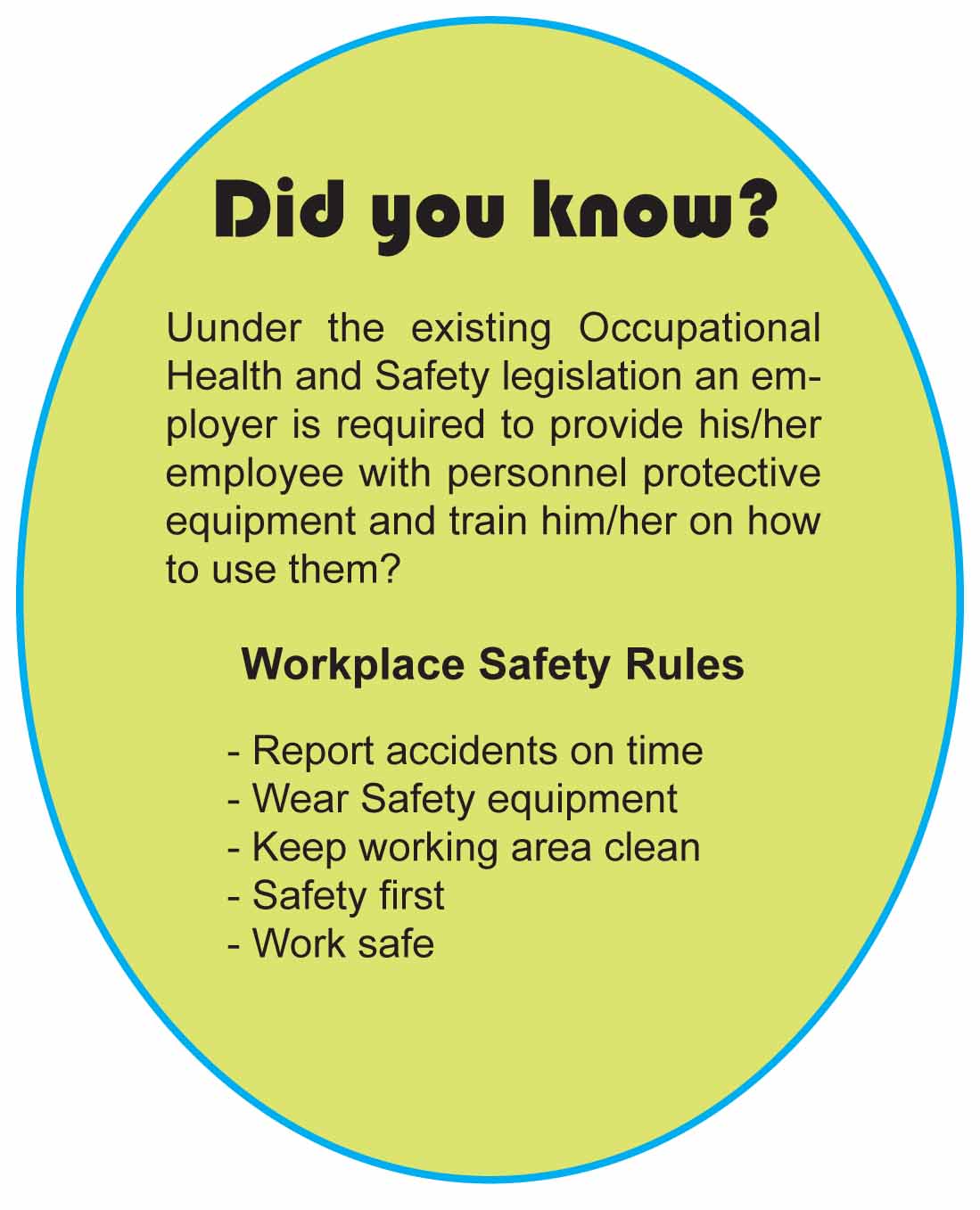
This is a brief guide to the main features of the Occupational Safety and Health (OSH) legislation, which sets out the laws about health and safety in Seychelles.
The OSH legislation applies to all:
• Workplaces
• Workplace activities
• Specified high risk plant
The objectives of the OSH legislation are to prevent anyone from being killed, injured, or contracting an illness because of a workplace, workplace activities or specified high-risk plant. This is achieved by preventing or minimizing exposure to risk.
The OSH legislation applies to you if you are:
• An employer;
• A worker
• A self-employed person;
• A person in control of workplaces;
• A principal contractor;
• A designer, manufacturer, importer or supplier of plant;
• A designer, manufacturer, importer or supplier of substances
• An owner of specified high risk plant;
• A visitor to a workplace e.g. customer or sales representative.
The Occupational Safety and Health legislation places an obligation on every person associated with a workplace in any way to ensure his or her own workplace health and safety and the workplace health and safety of others.