


Stranded marine mammal found dead on Silhouette |30 January 2014
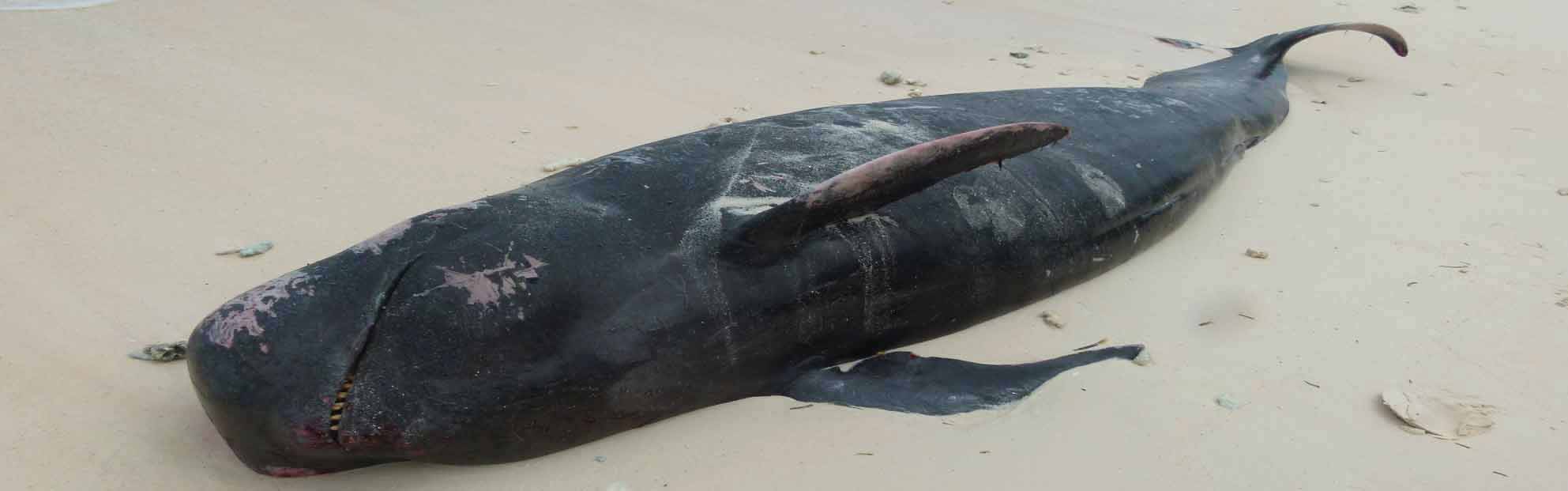
The stranded whale on Baie Cipailles beach on Silhouette
A large marine mammal was recently found dead on Baie Cipailles beach on Silhouette.
Staff from the Island Conservation Society (ICS) and the Islands Development Company (IDC) inspected the carcass, recorded body measurements, and collected tissue samples in order to identify the species.
The carcass has been interred with the aim of preserving and collecting the skeleton once decomposition of the organism has concluded.
The species has since been confirmed by the ICS to be a short-finned pilot whale, sometimes known as tropical pilot whale, (Globicephala macrorynchus).
The stranded animal was over four metres long, and female.
There were numerous scrapes and lacerations on its body, probably caused by hitting the rocks in the reef.
It had been spotted swimming inside the reef on the previous day, but the reason for the stranding is unknown.
A pod of pilot whales had been spotted swimming near Alphonse Atoll, a few days earlier.
Contrary to what their name suggests, pilot whales are in fact a species of dolphin -- the second largest after the killer whale (also a dolphin). They are social animals and offspring stay with their mother's pod for life, with a ratio of one male for every eight females. The pods are usually composed of 15-50 members and sometimes hundreds of dolphins are spotted in a single group. They are possibly converging for mating purposes, as interbreeding has never been documented. They give birth once every three to five years, calves nurse from their mothers for three years and other post-reproductive females in the group help to feed them.
Pilot whales are known as the ‘cheetahs of the deep’ for their high speed pursuits of squid (their favourite food) at depths of hundreds of metres. They also happen to be the cetacean most commonly found stranded on beaches -- usually in groups -- possibly as a result of geomagnetic anomalies, or sonar or seismic noise disrupting their navigation. However, when a single pilot whale is found stranded on its own, the cause is usually illness or injury.
In 2009, a similar stranding occurred on Desroches Island, which was also investigated by the ICS and was found to be a Deraniyagala’s Beaked Whale Mesoplodon hotaula. This is an extremely rare species known to science from just seven specimens, all of them in the tropical Indo-Pacific region.
As well as monitoring Silhouette's coastline, ICS staff also monitor and conduct anti-poaching activities throughout Silhouette Marine National Park, which extends from the shore to 400m off-shore, encircling the island.
By Melinda Curran and Angela Street
Island Conservation Society