


Presentation sheds light on chronic kidney failure |17 March 2014
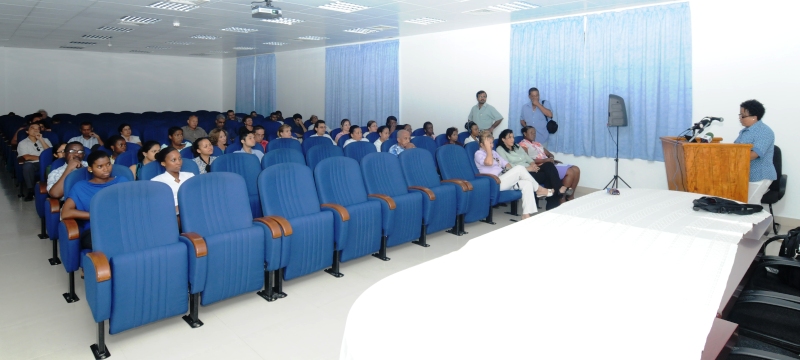
A presentation on chronic renal failure was held on Friday to mark World Kidney Day, which is celebrated on the second Thursday of March.
The presentation, prepared by nephrologist Dr Edelsy and nurse Elsia Sinon, took place at the Sheikh Khalifa Diagnostic Centre at the Seychelles Hospital.
Chronic kidney disease is very often called the silent killer, since initially there may be no symptoms of kidney failure. Kidneys are the organs which help filter waste products from the blood. They are also involved in regulating blood pressure, electrolyte balance, and red blood cell production in the body. If the kidneys fail completely, the only treatment options available may be dialysis or transplant.
Ms Sinon opened the presentation with an overview of the history of Seychelles’ work with dialysis patients.
“It started at the Seychelles Hospital on June 30, 1992. It was in a single room containing merely two machines and two nurses. At that time we had four patients who previously were sent to Reunion by the government to undergo treatment.”
However since they didn’t have a nephrologist, they needed to rely on the help of Dr George, a consultant, and liaise with doctors in Reunion. They also had only a portable reverse osmosis machine and not a proper water treatment plant.
1994 saw the arrival of Dr Tony Wong, a nephrologist, easing work pressure and in 1996 they moved to the current establishment with eight dialysis machines.
Currently Seychelles has 107 patients on dialysis and 15 machines in the hospital’s main unit and one in the ICU (Intensive Care Unit) for critically ill patients.
Dialysis is a very costly treatment for the government, costing approximately R440 per session and up to R3,100 per week. The budget for 2013 was R18,800,000.00 and this year it has been increased.
At the end of the presentation Sandra Sultan, a kidney donor, spoke of her experience travelling to Chennai for her cousin’s operation.
“I found myself in front of a medical board, being asked questions which were extremely difficult to answer, such as, ‘since you have three children, if you die on the operation table, who will take care of them?’” she said.
Dylan Waye-Hive, a 21-year-old patient suffering from chronic kidney disease (FSGS), also gave his testimony. Currently living without any kidneys, Dylan said his long and complicated story began at the tender age of six months. After a hernia repair surgery, which unfortunately resulted in a serious infection, he had to take a high dose of antibiotics and strong painkillers, which are suspected to be the reason for his renal complications. At the age of five, Dylan was immediately diagnosed with acute nephritic syndrome. His playground became the pediatric ward and his friends the doctors and nurses.
In 2001, at the age of eight, he became the youngest dialysis patient recorded in Seychelles. For such a young child the long sessions were such a terrifying and painful process. It was hard to comprehend that the big needles, long tubes and the endless flowing of blood on the machine were meant to keep him alive.
In 2003 due to extreme hypertension, Dylan fell into a coma for ten days, which later led to the removal of both failed kidneys. Thankfully that same year, his aunt offered to donate one of her kidneys. His life was suddenly changing for the better. Dylan planned on catching up with school and achieving his dreams.
“Unfortunately in 2007, due to high level of intoxication from medication, my donated kidney failed. I was once again on dialysis for life support. I was angry and devastated, I felt cheated of my second chance at living a normal life. Soon after, I travelled to India for the removal of my donated kidney,” explained Dylan.
With other complications that followed, Dylan is now depending on high calcium baths during his dialysis.
Ms Sinon added that those who have any high risk factors such as diabetes, hypertension, obesity or have family members with the same condition should get their kidney functions checked.
Overuse of common drugs such as aspirin, ibuprofen and acetaminophen (paracetamol) can also cause kidney damage, as well as hard drugs and substances such as heroin, cocaine and alcohol.