

Up Close … with Mickey Arnephy, potter & ceramist |24 June 2014
‘Pottery is a form of therapy’
By Sedrick Nicette
It is never an easy task for us journalists to find people to talk to for our ‘Up Close’ column, and my task last week was not made easy as sometimes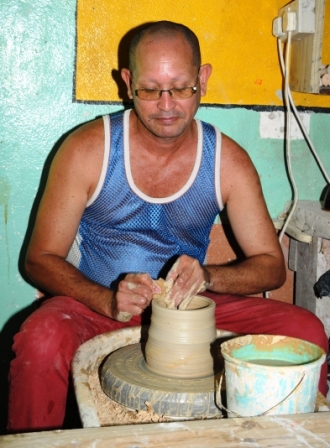 we find ourselves let down for various reasons.
Thankfully, we journalists stick together, and one of my colleagues offered me the chance to meet an artist.
The word ‘artist’ surely implies a lot of things -- a painter, musician, sculptor, etc… However, the man I met does something that I found very interesting upon my visit to his studio. Dear readers, meet Mickey Arnephy … a potter and ceramist.
Childhood
“During my childhood, I can say that I passed through many districts on Mahé, Praslin as well as La Digue, as my father was a policeman, which meant he was rotated a lot at work and had to move from one place to another,” Mr Arnephy explained when talking about his childhood.
“I spent most of my school years at Anse Royale, before moving to Port Glaud and afterwards I went to Anse Boileau secondary,” he added.
Mr Arnephy said that his interest in ceramic works came while he was still in school, when a group of professionals came to the school to introduce ceramics as they were planning to open a school for that kind of work.
“I was really impressed when I saw these people, especially when the professor used a bit of clay and turned it into an object. For me, that was something fantastic which really grabbed my attention,” he said. Mr Arnephy said that since that day he has been passionate about ceramics and decided to pursue this line of work.
“Today I have no regrets about it,” he added with a smile.
‘Later Rouz’
Many people may still remember the pottery factory called Seypot, which was located next to the Les Mamelles clinic. Mr Arnephy revealed that he was part of the cooperative, before moving to work in hotels.
Before starting his own business, Mr Arnephy who has been in the pottery/ceramic art since 1979, got the chance to attend a two-year course in France, where he managed to hone his skills.
Locate at the Craft Village at Domaine de Val des Près in the district of Au Cap, Mr Arnephy’s studio is aptly named ‘Later Rouz’, which in itself defines his work as he uses a lot of clay in his artworks.
“I decided to choose ‘Later Rouz’ as the name for my studio as there is not a real creole name for ceramics. When I was at school, we used to ride at the back of pick-up trucks to collect red earth for our work and people always called us ‘later rouz’. I therefore decided to use this as the name for my studio,” said Mr Arnephy.
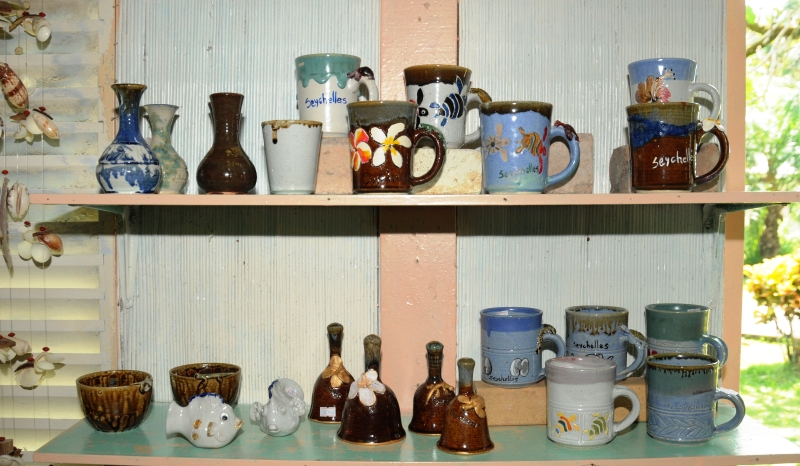
The ceramic art studio is located in an area that is not easy to spot as it is not by the main road where people can see it, but upon my arrival there I was not disappointed. It was a pleasant experience to see the many astounding creations that have been made from something that is all around us but taken for granted. Cups, ash trays, jewelry boxes, etc… were some of the things that caught my eye while there.
I was also surprised when I saw glass bottles that had been flattened as if they were made of plastic. Mr Arnephy explained: “For that, I went for training in Kenya where I learned how to work with glass and I therefore decided to incorporate glass in some of my ceramic works as well.”
Indeed from what I saw, they are truly works of art.
Process
Many of you, our readers have surely seen pottery being done in films, and for many the first thought goes towards the movie ‘Ghost’ which has a memorable scene involving this art. But, how is it really done? Mr Arnephy explained: “First you need to collect the red earth and let it dry, then add water to it so it becomes a bit like mud and then filter it. The filtering process removes small bits of rocks so that you are left with just the soft soil that resembles the texture of flour.
“After the filtering is done, you let it settle to remove the water,” Mr Arnephy continued. “It then becomes a lump which we call clay.”
Mr Arnephy explained that you need to be precise when weighing how much of the clay to use.
“If I am going to make several of the same objects, I have to separate the clay precisely so that all the objects are of the same size.”
The clay then goes on the spinning wheel where he shapes it into the desired object and then lets it dry.
“It then has to go into the oven where it is baked at about 1000°c to harden,” added Mr Arnephy.
After adding the colour to it, it goes back into the oven for the paint on it to dry. It takes between 10 – 20 minutes to complete one of the objects.
Mr Arnephy however has expressed his disappointment at the lack of support from government to pottery especially in schools.
“In other countries pottery is something that is taught in schools, but here in Seychelles it is almost non-existent at our institutes,” Mr Arnephy noted.
“I have always wanted to renovate the pottery school at Mont Fleuri but it has fallen on deaf ears,” said Mr Arnephy. “Pottery is a form of therapy that could be used as a means to keep our children off the streets and get them to do something meaningful with their lives and earn a living in the process.”
My visit to the ‘Later Rouz’ studio was indeed very interesting and it shows that although it is an art that has lost its appeal to the public, it does produce amazing objects which can be used as decorations or even for practical uses as well. I would urge those who have never visited the craft village at Au Cap to do so, especially the youths as it is something that will leave a lasting impression on them.
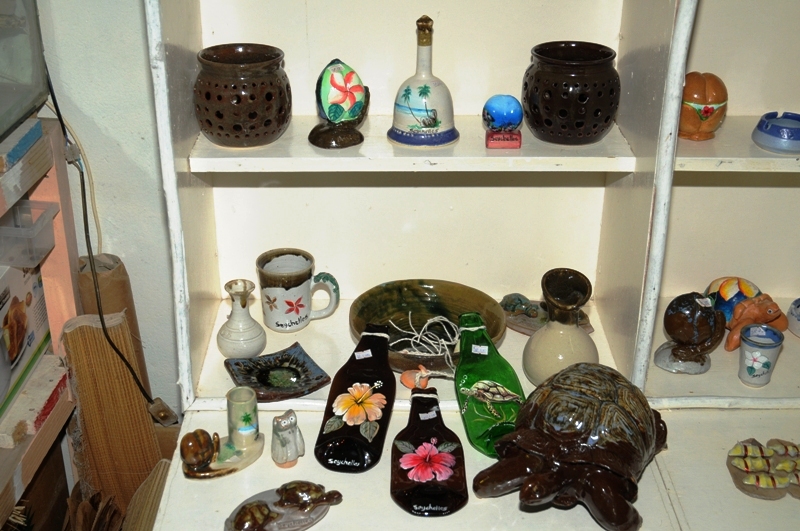
Some of Mr Arnephy’s astounding ceramic works