


Seychelles hosts anti-doping forum |29 August 2017
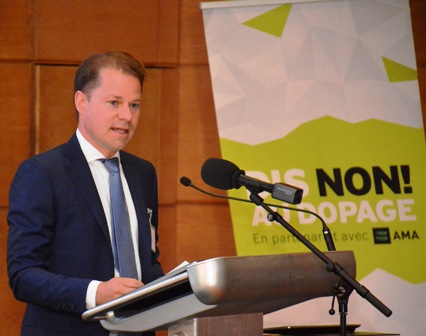 With more doping in sports cases being reported in the media in recent years, the fight against the use of performance-enhancing drugs has become more important than ever. It is with this in mind that Seychelles is, as of yesterday, holding a four-day Think Tank Forum on the subject, with the aim of finding new ways to eliminate this element from African sports.
The forum, which has brought together officials from various African nations as well as Seychelles is being held at the Eden Bleu Hotel. It was officially opened yesterday morning by the Minister for Youth, Sports and Culture Mitcy Larue, in the presence of various officials from the sports family, including principal secretary for culture Cecile Kalebi, special advisor for sports Jean Larue, National Sports Council chief executive Giovanna Rousseau and members of various sports federations and associations in the country.
The forum is also being attended by officials from the African Union (AU) and World Anti-Doping Agency (Wada), while the guest speakers are Olivier Niggli, director general of Wada; Rene Bouchard, an advisor to Wada; and Hassan Wario Arero, cabinet secretary for the Ministry of Sports, Culture and Arts of Kenya.
In his address to those present, Mr Niggli thanked Seychelles for the invitation and hospitality.
“Attending this forum in Africa is very important as we want to increase the capacity for more commitment in sports,” said Mr Niggli.
He added that during the forum, those present will see how much doping affects athletes, sports and the values sports bring to society.
It was Minister Larue though who officially opened the forum and in her address, she explained that the forum will help towards a doping-free Africa.
“It is clear that the core values and integrity of sports are being endangered. As true guardians of the values and spirit of sport, we have to be proactive, objective, balanced and transparent in our decisions as we wrestle this scourge,” said the minister.
She added: “Sports goes beyond a measure of athletic excellence. It teaches us about honesty, commitment, fair play and ethics we can extrapolate in all walks of life.”
“True winners are those who achieve their goals through hard work, dedication, training, motivation and rising to all challenges their sports present. However, a “win at all cost” ethos that undermines the very integrity of sport has taken centre stage,” she continued.
Finally, she urged all member states and delegations to continue their hard work to enhance Africa’s role in the fight against doping in sports.
In competitive sports, doping refers to the use of banned athletic performance-enhancing drugs by athletic competitors, where the term doping is widely used by organisations that regulate sporting competitions. The use of banned drugs to enhance performance is considered unethical, and therefore prohibited, by most international sports organisations, including the International Olympic Committee. Furthermore, athletes (or athletic programmes) are taking explicit measures to evade detection exacerbates the ethical violation with overt deception and cheating.
Historically speaking, the origins of doping in sports goes back to the very creation of sport itself. From ancient usage of substances in chariot racing to more recent controversies in baseball and cycling, popular views among athletes have varied widely from country to country over the years. The general trend among authorities and sporting organisations over the past several decades has been to strictly regulate the use of drugs in sport. The reasons for the ban are mainly the health risks of performance-enhancing drugs, the equality of opportunity for athletes, and the exemplary effect of drug-free sport for the public. Anti-doping authorities state that using performance-enhancing drugs goes against the "spirit of sport".
Wada’s mission is to lead a collaborative worldwide movement for doping-free sport.
Wada was established in 1999 as an international independent agency composed and funded equally by the sport movement and governments of the world. Its key activities include scientific research, education, development of anti-doping capacities, and monitoring of the World Anti-Doping Code (Code) – the document harmonising anti-doping policies in all sports and all countries.
S. N.